

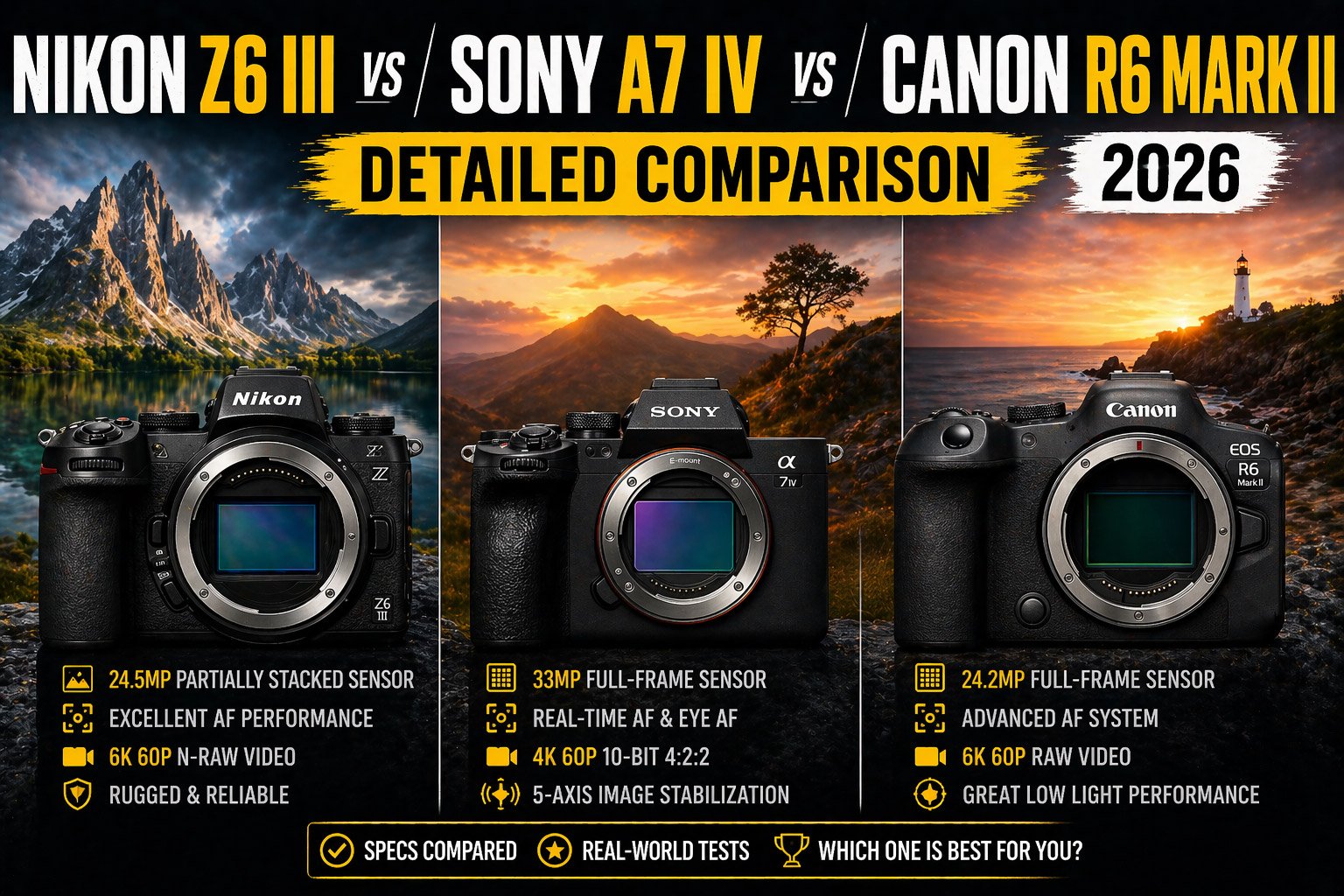
Nikon Z6 III vs Sony A7 IV vs Canon R6 Mark II (Hybrid Camera Comparison)
*Some links in this article are affiliate links. If you purchase through them, it helps support my work at no extra cost to you.
==========
Last Updated: August 2026
2026 Update: New Hybrid Cameras (What’s Changed)
The Nikon Z6 III, Sony A7 IV, and Canon EOS R6 Mark II remain three of the most popular enthusiast and professional hybrid cameras available. While newer models such as the Canon EOS R6 Mark III and Sony a7V have been introduced, these cameras continue to offer excellent value and are still widely recommended depending on your shooting priorities.
👉 If you’re considering upgrading or want the latest model:
Canon EOS R6 Mark III Review
👉Looking for a broader breakdown of the best hybrid cameras available right now?
Best Hybrid Cameras 2026 Guide
Nikon Z6 III vs Sony A7 IV vs Canon EOS R6 Mark II
If you're deciding between the Nikon Z6 III, Sony A7 IV, and Canon EOS R6 Mark II, you're looking at three of the most capable hybrid cameras available for photographers and content creators.
Although newer cameras have entered the market, these three models remain excellent choices thanks to their strong image quality, dependable autofocus, and professional video features. They continue to offer outstanding value for photographers who shoot everything from concerts and events to landscapes, portraits, and commercial work.
Each camera has its own strengths.
The Nikon Z6 III offers one of the best all-around balances of photography and video performance.
The Sony A7 IV continues to set a high standard for autofocus and subject tracking.
The Canon EOS R6 Mark II delivers an excellent blend of usability, speed, and hybrid capabilities.
This guide compares all three cameras using real-world shooting experience instead of simply listing specifications, helping you choose the one that best matches your shooting style.
Comparison Table
| Feature | Nikon Z6 III | Sony A7 IV | Canon R6 II |
|---|---|---|---|
| Resolution | ✓ | ✓ | ✓ |
| Autofocus | ✓ | ⭐ | ✓ |
| Video | ⭐ | ✓ | ⭐ |
| Low Light | ⭐ | ✓ | ✓ |
| Ergonomics | ⭐ | Good | Excellent |
| Best For | Events | Wildlife | Hybrid |
Resolution
Nikon Z6 III: ✓
Sony A7 IV: ✓
Canon R6 II: ✓
Autofocus
Nikon Z6 III: ✓
Sony A7 IV: ⭐
Canon R6 II: ✓
Video
Nikon Z6 III: ⭐
Sony A7 IV: ✓
Canon R6 II: ⭐
Low Light
Nikon Z6 III: ⭐
Sony A7 IV: ✓
Canon R6 II: ✓
Ergonomics
Nikon Z6 III: ⭐
Sony A7 IV: Good
Canon R6 II: Excellent
Best For
Nikon Z6 III: Events
Sony A7 IV: Wildlife
Canon R6 II: Hybrid
Quick Comparison Summary
Best Overall: Nikon Z6 III
Excellent low-light performance, fast operation, strong video features, and a balanced shooting experience make the Z6 III the best all-around choice for most photographers.
Best Autofocus: Sony A7 IV
Sony's industry-leading subject detection and tracking remain among the most reliable systems available for wildlife, sports, concerts, and fast-moving subjects.
Best Hybrid Camera: Canon EOS R6 Mark II
The R6 Mark II provides one of the best balances of photography and video performance, making it an excellent choice for creators who regularly shoot both.
Best Value Today: Canon EOS R6 Mark II
With recent price reductions, the R6 Mark II offers exceptional performance for photographers looking to maximize value without sacrificing professional features.
What Matters in a Hybrid Camera
Before comparing specs, here’s what actually matters:
low-light performance
autofocus reliability
video capability
usability and workflow
If you shoot concerts or events, low-light and autofocus matter the most.
Specification Comparison
Resolution
• Nikon Z6 III: 24.5 MP
• Sony A7 IV: 33 MP
• Canon EOS R6 Mark II: 24.2 MP
Continuous Shooting
• Z6 III: Up to 20 fps RAW
• A7 IV: Up to 10 fps
• R6 Mark II: Up to 40 fps electronic
Video
• Z6 III: Internal 6K RAW and advanced video options
• A7 IV: Oversampled 4K with strong creator features
•R6 Mark II: Oversampled 4K up to 60p
Related: → Best Video Settings for Hybrid Cameras
Image Stabilization
All three cameras include excellent in-body image stabilization, making handheld photography and video significantly easier.
Image Quality
All three cameras produce excellent image quality, but they prioritize different strengths.
The Sony A7 IV offers the highest resolution of the group at 33 megapixels, giving photographers more flexibility for cropping and large prints.
The Nikon Z6 III emphasizes speed, low-light performance, and dynamic range while still producing highly detailed files suitable for professional work.
The Canon EOS R6 Mark II uses a 24-megapixel sensor that delivers clean images, attractive color, and manageable file sizes that fit many professional workflows.
For most photographers, image quality differences are relatively small compared to differences in autofocus, handling, and lens selection.
Lens Ecosystem
Choosing a camera system is also choosing a lens ecosystem.
Sony currently offers the widest native mirrorless lens selection, including excellent third-party options from Sigma, Tamron, and Samyang.
Canon's RF lineup continues to expand with outstanding optical quality, particularly among Canon's professional L-series lenses.
Nikon's Z-mount system has grown rapidly and now includes an impressive range of professional lenses known for excellent sharpness and optical performance.
All three systems provide enough options for nearly every photography genre, so your preferred lenses and future upgrade plans should play an important role in your decision.
👉 For more info on lenses:
→ Best Lenses for Concert Photography
👉 For a full breakdown of real-world concert settings:
→ Best Camera Settings for Concert Photography
👉 For handling difficult lighting:
→ Concert Photography Low Light Tips
Nikon Z6 III (Best Overall Balance)

The Nikon Z6 III is one of the most well-rounded hybrid cameras available.
Why It Stands Out
strong low-light performance
fast and responsive shooting
excellent video capabilities (6K options)
balanced workflow
Real-World Use
Performs well in:
concerts
events
hybrid photo/video work
Where It Falls Short
not the highest resolution
not as autofocus-heavy as Sony
Bottom Line
If you want one camera that handles almost everything well, this is one of the safest choices.
👉 Check current pricing on Amazon
Sony A7 IV (Best Autofocus)

The Sony A7 IV stands out for its autofocus system.
Why It Stands Out
industry-leading subject tracking
very reliable focus in difficult lighting
strong all-around performance
Real-World Use
Best for:
fast-moving subjects
unpredictable environments
situations where focus accuracy is critical
Where It Falls Short
menus can feel complex
not as video-focused as some competitors
Bottom Line
If autofocus reliability is your priority, this is one of the strongest options.
👉 Check current pricing on Amazon
Canon EOS R6 Mark II (Best Hybrid Performance)

The Canon R6 Mark II is built for hybrid shooters.
Why It Stands Out
excellent photo + video balance
strong autofocus system
great usability
Real-World Use
Ideal for:
creators shooting both photo and video
fast-paced environments
event coverage
Where It Falls Short
lower resolution
slightly less dynamic range in some situations
Bottom Line
If you want a camera that handles both stills and video equally well, this is a strong choice.
👉 Check current pricing on Amazon
If you're already considering the Canon ecosystem but want the latest performance improvements:
👉 See the Canon EOS R6 Mark III Review
Key Differences
Low-Light Performance
All three cameras perform well in difficult lighting, but the Z6 III offers a slight advantage for concerts, events, and other demanding low-light situations.
Autofocus
Sony continues to lead in subject detection and tracking, while Canon follows closely with excellent real-world performance. Nikon has made major improvements with the Z6 III and performs exceptionally well for most photographers.
Video
The Z6 III provides some of the most advanced video capabilities in this group, while Canon remains an excellent hybrid option for creators producing both stills and video.
Resolution
Photographers who frequently crop or produce very large prints may appreciate the Sony's additional resolution.
Ease of Use
Canon offers one of the easiest camera systems to learn, while Nikon provides an intuitive layout with extensive customization. Sony has improved its menu system but still has a steeper learning curve.
Which Camera Should You Choose?
Choose Nikon Z6 III if:
you want the best overall balance
you shoot concerts or events
you value low-light performance
Choose Sony A7 IV if:
autofocus is your top priority
you shoot fast-moving subjects
you want strong tracking
Choose Canon R6 Mark II if:
you shoot both photo and video equally
you want a user-friendly system
you value hybrid performance
Concert and Festival Use
All three cameras perform well in concerts.
But when you add festivals:
longer days
more movement
more lighting variation
your choice matters more.
👉 If you plan to shoot festivals, see:
→ Music Festival Photography Guide
Camera vs Lens (Don’t Ignore This)
Many beginners focus on upgrading their camera body first, but in concert photography, the lens often has a bigger impact on your results.
A fast lens with a wide maximum aperture (such as f/1.8 or f/2.8) lets in significantly more light than a typical kit lens. That means you can use faster shutter speeds, lower ISO settings, and create stronger subject separation in challenging concert lighting.
If you're deciding where to spend your budget, a capable camera paired with a quality fast lens will usually outperform an expensive camera paired with a slow kit lens.
👉 See: Best Lenses for Concert Photography
Final Thoughts
There isn't a wrong choice among these three cameras.
If you prioritize overall balance, low-light performance, and professional video features, the Nikon Z6 III is the strongest all-around option.
If autofocus performance is your highest priority, the Sony A7 IV remains one of the best cameras available.
If you want an outstanding hybrid camera with excellent ergonomics and an easy-to-use interface, the Canon EOS R6 Mark II continues to be one of the best values on the market.
Rather than focusing solely on specifications, think about the type of photography you shoot most often, the lenses you plan to invest in, and the workflow that fits your style. Those factors will have a much greater impact on your long-term satisfaction than small differences in megapixels or frame rates.
Frequently Asked Questions
Which camera has the best autofocus?
The Sony A7 IV offers the strongest autofocus and subject tracking of these three cameras, making it an excellent choice for wildlife, sports, concerts, and other fast-moving subjects.
Which camera performs best in low light?
The Nikon Z6 III has a slight advantage in low-light performance, although all three cameras produce excellent results in challenging lighting conditions.
Is the Canon EOS R6 Mark II good for video?
Yes. The Canon EOS R6 Mark II is one of the strongest hybrid cameras available, offering excellent video quality alongside professional still photography performance.
Which camera is best for concert photography?
All three cameras perform well for concert photography. The Nikon Z6 III is the best overall choice for many photographers because it combines strong low-light performance, fast operation, and excellent video capabilities.
Which camera has the highest resolution?
The Sony A7 IV offers the highest resolution at 33 megapixels, making it a good choice for photographers who frequently crop images or produce large prints.
Which camera is easiest to use?
The Canon EOS R6 Mark II is generally considered the easiest to learn thanks to its intuitive menus, comfortable controls, and straightforward shooting experience.
Do lenses matter more than the camera body?
In many cases, yes. Investing in high-quality lenses often has a greater impact on image quality than upgrading to a more expensive camera body.
==========
Explore more:
