

Best Lenses for Concert Photography (Low Light & Live Music Guide)
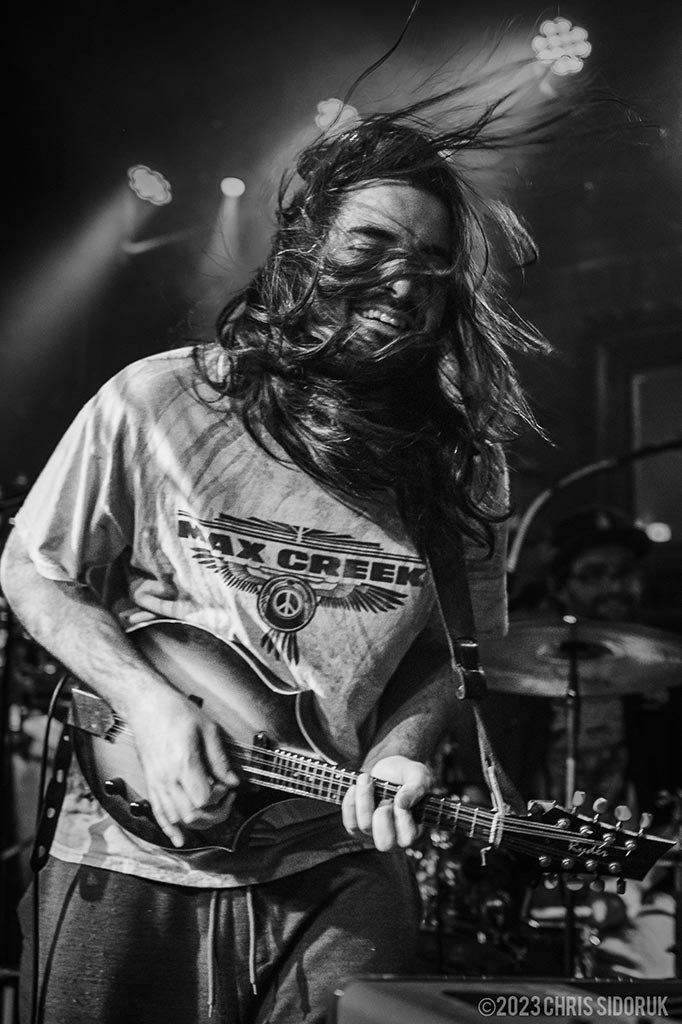
Creamery Station at Arch Street Tavern in Hartford, CT | photo- ©2023 Chris Sidoruk
*Some links in this article are affiliate links. If you purchase through them, it helps support my work at no extra cost to you.
==========
Last Updated: 07/25/2026
Concert photography is one of the most demanding environments for any lens.
You are working with:
Extremely low light
Fast-moving performers
Unpredictable stage lighting
Limited shooting positions
Constantly changing compositions
A lens that performs well in a studio or outdoor setting may struggle when you are photographing a musician moving quickly under inconsistent stage lighting.
The right lens can make the difference between:
A sharp image and a missed moment
A noisy underexposed photo and a clean usable file
A simple snapshot and a professional live performance image
After photographing concerts in clubs, theaters, outdoor venues, and festivals, I have found that the best concert photography lenses are not always the most expensive ones.
The best lens depends on:
Venue size
Distance from the stage
Lighting conditions
Shooting position
Your photography style
This guide focuses on real-world concert lens performance, not just technical specifications.
Real Concert Photography Examples
These recommendations are based on photographing live performances in environments such as:
Small clubs with difficult lighting
Theater performances
Outdoor concert venues
Music festivals
Examples include:
Concert photography is unpredictable.
One song may require a wide environmental image showing the entire stage, while the next moment requires a tight portrait of a guitarist or vocalist.
That is why lens flexibility matters so much.
Quick Picks: Best Concert Photography Lenses in 2026
| Category | Best Choice |
|---|---|
| Best Overall Concert Lens | 24–70mm f/2.8 |
| Best Low-Light Lens | 50mm f/1.8 or faster prime |
| Best Festival Lens | 70–200mm f/2.8 |
| Best Portrait Lens | 85mm f/1.8 or f/1.4 |
| Best Budget Lens | 50mm f/1.8 |
| Best Lightweight Setup | 35mm or 50mm prime |
| Best Professional Two-Lens Setup | 24–70mm f/2.8 + 70–200mm f/2.8 |
Best Overall Concert Lens
24–70mm f/2.8
Best Low-Light Lens
50mm f/1.8 or faster prime
Best Festival Lens
70–200mm f/2.8
Best Portrait Lens
85mm f/1.8 or f/1.4
Best Budget Lens
50mm f/1.8
Best Lightweight Setup
35mm or 50mm prime
Best Professional Two-Lens Setup
24–70mm f/2.8 + 70–200mm f/2.8
My Recommended Concert Photography Lens Setup
There is no single perfect concert lens.
A photographer covering a small club show has completely different needs from someone photographing a large festival stage from 100 feet away.
For most concert photographers, the ideal setup is:
One-Lens Setup
24–70mm f/2.8
The best all-around choice.
It provides enough flexibility for:
Wide stage images
Individual performer shots
Small venue photography
Photo pit coverage
If you could only bring one lens, this is usually the lens I would recommend.
Two-Lens Professional Setup
24–70mm f/2.8 + 70–200mm f/2.8
This is the classic professional concert photography combination.
Together, these lenses cover:
Wide environmental shots
Full-body performer images
Tight portraits
Distant festival stages
This combination gives you flexibility without constantly changing lenses.
Low-Light Club Setup
35mm + 50mm + 85mm Fast Primes
For extremely dark venues, fast primes can be the difference between getting the shot and missing it.
Advantages:
Wider apertures
Better low-light performance
Strong subject separation
Smaller and lighter setup
This approach works especially well for:
Small clubs
Intimate performances
Documentary-style concert photography
What Actually Matters in a Concert Photography Lens
When choosing a lens for live music photography, specifications only tell part of the story.
The most important factors are:
Aperture
Autofocus performance
Focal length flexibility
Sharpness at high ISO settings
Handling and reliability
Aperture: The Most Important Concert Lens Feature
Concert photography is usually limited by available light.
Stage lighting can change constantly.
One moment you may have a bright spotlight on a singer.
The next moment the performer may move into darkness.
A wider aperture allows more light to reach the camera sensor.
Examples:
f/1.4
f/1.8
f/2
f/2.8
Compared with:
f/4
f/5.6
A faster lens gives you more flexibility with:
Shutter speed
ISO
Motion freezing
Background separation
Why Faster Apertures Matter for Concerts
A wider aperture allows you to:
Use Faster Shutter Speeds
Musicians move constantly.
A faster shutter speed helps freeze:
Guitar movement
Drum hits
Vocal expressions
Stage motion
Keep ISO Lower
Low-light venues often require higher ISO settings.
A faster lens can help maintain:
Cleaner files
Better shadow detail
More editing flexibility
Create Better Subject Separation
Wide apertures help isolate performers from distracting backgrounds.
This is especially useful when photographing:
Vocalists
Guitarists
Solo performances
Emotional moments on stage
Autofocus Performance Matters More Than Maximum Sharpness
A technically perfect lens is not useful if it cannot focus quickly enough.
Concert photography requires autofocus that can handle:
Moving performers
Changing lighting
Low contrast situations
Fast action
Modern mirrorless systems have improved dramatically, but lens autofocus performance still matters.
A slightly less sharp lens that consistently locks focus can produce better real-world results than a sharper lens that struggles.
Focal Length: Choosing the Right Lens for Your Venue
The best focal length depends heavily on where you are shooting.
Small Clubs
Recommended:
24–70mm
35mm prime
50mm prime
Why:
You are often close to performers
Wide environmental shots are important
Space is limited
Medium Venues
Recommended:
24–70mm f/2.8
70–200mm f/2.8
85mm prime
Why:
More distance from stage
More opportunities for portraits
More varied compositions
Large Festivals
Recommended:
24–70mm f/2.8
70–200mm f/2.8
100–400mm for some situations
Why:
You may be farther away
Performers occupy less of the frame
Compression becomes more important
Sharpness at High ISO Matters
Concert photographers often shoot at:
ISO 3200
ISO 6400
ISO 12800
Higher depending on conditions
A good concert lens should maintain:
Strong contrast
Good detail
Reliable autofocus
Minimal softness wide open
A lens that performs well at f/1.8 or f/2.8 can dramatically improve your keeper rate.
A Fast Lens Will Usually Improve Results More Than a Camera Upgrade
Many photographers focus on upgrading camera bodies first.
However, in concert photography, a faster lens often provides a bigger real-world improvement.
A lens upgrade can give you:
More available light
Better subject isolation
More creative options
Higher percentage of usable images
A modern camera body paired with a slow lens may still struggle in dark venues.
A good lens paired with a capable camera body can produce professional results.
Related Guides
To get the most out of your concert photography gear:
→ Best Cameras for Concert Photography
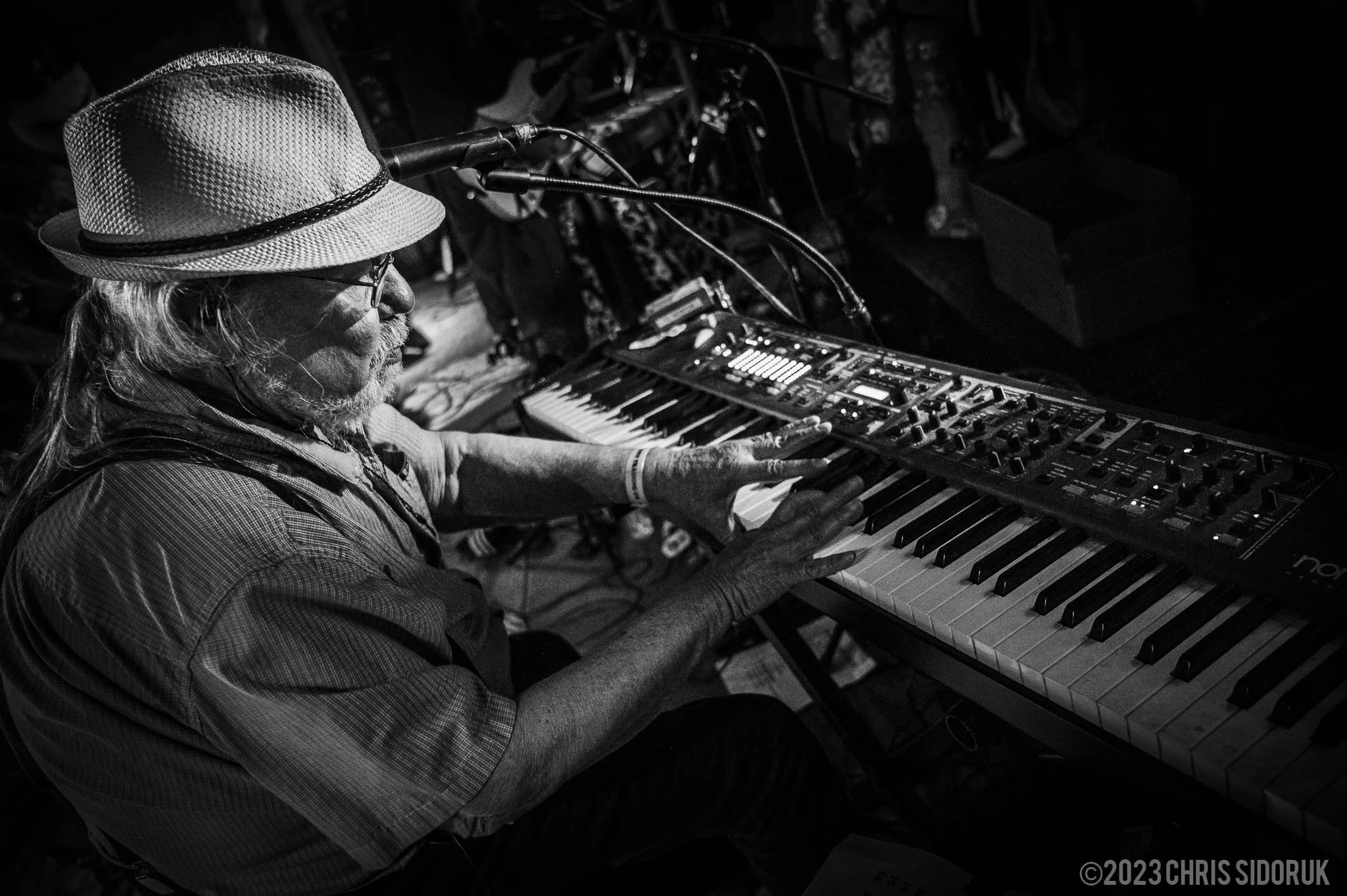
Jon Truelson of Creamery Station during a keyboard solo. | photo- ©2023 Chris Sidoruk
24–70mm f/2.8 Lens (Best Overall Concert Photography Lens)
The 24–70mm f/2.8 is the most versatile and widely recommended lens for concert photography.
For many photographers, this is the first professional-level lens worth investing in because it handles the majority of live music situations extremely well.
It provides the flexibility to capture:
Full-stage compositions
Individual performers
Medium portraits
Instrument details
Crowd interaction
without constantly changing lenses.
In unpredictable concert environments, that flexibility is extremely valuable.
Why the 24–70mm f/2.8 Works So Well for Concerts
Constant f/2.8 Aperture
A constant aperture means the lens maintains the same maximum aperture throughout the zoom range.
Whether you are shooting at:
24mm
35mm
50mm
70mm
you still have access to f/2.8.
This provides:
Consistent exposure
Predictable low-light performance
Faster shutter speeds
Better control over depth of field
Flexible Focal Range
The 24–70mm range covers the focal lengths most concert photographers use.
24mm
Great for:
Full-stage images
Environmental shots
Crowd interaction
Dramatic lighting setups
35mm–50mm
Great for:
Natural-looking performer images
Small venue photography
Documentary-style shots
70mm
Great for:
Tight performer portraits
Facial expressions
Instrument details
Real-World Concert Uses
The 24–70mm f/2.8 is ideal for:
Small Clubs
Where you may be:
Close to the stage
Moving between limited positions
Photographing performers at short distances
Medium-Sized Venues
Where you need flexibility between:
Wide stage coverage
Individual musician portraits
Changing compositions
Photo Pit Photography
The photo pit is one of the best environments for this lens.
You often have only a few songs to capture the performance, so changing lenses wastes valuable time.
The 24–70mm lets you react quickly.
Where the 24–70mm f/2.8 Falls Short
Despite being one of the best overall options, it is not perfect.
Not as Bright as Prime Lenses
A 50mm f/1.8 or 85mm f/1.8 allows significantly more light.
In extremely dark venues, a prime lens can provide:
Lower ISO
Faster shutter speeds
More background separation
Limited Reach
At larger festivals, 70mm may not be enough.
If you are shooting from farther away, a 70–200mm or longer lens becomes much more useful.
Bottom Line
If you only buy one concert photography lens:
The 24–70mm f/2.8 is the safest and most versatile choice.
It is the lens most photographers can build an entire concert workflow around.
Best 24–70mm f/2.8 Lenses for Concert Photography
The best choice depends on your camera system.
Nikon 24–70mm f/2.8 Options
Nikon NIKKOR Z 24–70mm f/2.8 S II
A premium mirrorless zoom designed for demanding professional workflows.
Strengths:
Excellent sharpness
Fast autofocus
Professional build quality
Strong low-light performance
Best for:
Nikon Z photographers
Professional concert and event work
Canon 24–70mm f/2.8 Options
Canon RF 24–70mm f/2.8 L IS USM
A professional RF-mount zoom with:
Excellent image quality
Fast autofocus
Image stabilization
The stabilization is helpful for slower handheld shots, although shutter speed is usually the priority for concerts.

Canon EF 24–70mm f/2.8L II USM
Still an excellent option for DSLR photographers.
Known for:
Reliability
Sharpness
Professional durability
Sony 24–70mm f/2.8 Option
Sony FE 24–70mm f/2.8 GM II
One of the most popular professional concert photography lenses.
Strengths:
Extremely sharp
Fast autofocus
Compact compared with many professional zooms
A strong choice for Sony shooters photographing:
Concerts
Touring artists
Events
Value Alternative
Tamron 28–75mm f/2.8 G2
A popular alternative for photographers looking for professional performance at a lower price.
Advantages:
Lightweight
Sharp
Affordable
Excellent value
The tradeoff is slightly less wide coverage compared with a traditional 24–70mm.
70–200mm f/2.8 Lens (Best Concert Lens for Reach)
The 70–200mm f/2.8 is the second essential lens for many professional concert photographers.
While the 24–70mm handles close and medium-range coverage, the 70–200mm solves the biggest problem at larger venues:
distance.
When you cannot get close to the performer, this lens becomes invaluable.
Why the 70–200mm f/2.8 Works So Well
Long Reach
The 70–200mm range allows you to capture:
Tight portraits
Facial expressions
Instrument details
Stage interactions
from much farther away.
Subject Isolation
The longer focal length creates beautiful compression.
Benefits include:
Cleaner backgrounds
Strong performer separation
More cinematic images
This is especially useful when stage backgrounds include:
Lighting equipment
Crowds
Distracting elements
Constant f/2.8 Aperture
Like the 24–70mm, the 70–200mm maintains f/2.8 throughout the zoom range.
This provides:
Consistent exposure
Better low-light capability
Professional-level performance
Real-World Uses
The 70–200mm f/2.8 is best for:
Outdoor Festivals
Especially when:
The stage is large
The photo pit is limited
You are farther from performers
Large Venues
Examples:
Theaters
Arenas
Large concert halls
Shooting From the Crowd
Sometimes photographers do not have pit access.
A 70–200mm can still produce strong images from farther back.
Where the 70–200mm Falls Short
Size and Weight
This is the biggest drawback.
Professional 70–200mm lenses are:
Large
Heavy
Physically demanding
After several hours of shooting, the weight becomes noticeable.
Less Useful in Tight Venues
In a small club, you may simply be too close.
A 70–200mm can become difficult to use when:
The stage is only a few feet away
Lighting is extremely dark
Space is limited
Bottom Line
The 70–200mm f/2.8 is the lens you buy when distance becomes your biggest challenge.
For photographers covering:
Festivals
Larger venues
Touring performances
it is one of the most valuable lenses available.
Best 70–200mm f/2.8 Lenses for Concert Photography
Nikon NIKKOR Z 70–200mm f/2.8 VR S II
A flagship Nikon Z telephoto zoom.
Strengths:
Exceptional sharpness
Fast autofocus
Professional reliability
Canon RF 70–200mm f/2.8 L IS USM
A popular professional option with:
Excellent image stabilization
Compact design
Strong autofocus

Sony FE 70–200mm f/2.8 GM OSS II
A widely used professional lens for:
Concert photography
Sports
Events
Strengths:
Fast focusing
Sharp images
Improved portability compared with earlier versions
Tamron 70–200mm f/2.8 Di VC G2
A strong value option.
Best for photographers who want:
Professional focal range
f/2.8 performance
Lower cost
Professional Two-Lens Concert Photography Setup
For photographers who regularly cover live music, the combination of:
24–70mm f/2.8
plus
70–200mm f/2.8
is one of the most proven setups available.
Together they provide:
Wide environmental images
Performer portraits
Festival coverage
Venue flexibility
Minimal lens changes
This combination is used by many professionals because it solves the two biggest concert photography challenges:
Changing distance and unpredictable lighting.
Fast Prime Lenses (Best Low-Light Performance)
While professional zoom lenses like the 24–70mm f/2.8 and 70–200mm f/2.8 are the foundation of many concert photography kits, fast prime lenses remain some of the most valuable tools for challenging lighting environments.
A prime lens has a fixed focal length, meaning it does not zoom.
Examples:
35mm
50mm
85mm
The tradeoff is simple:
You lose focal length flexibility, but gain:
Wider apertures
Better low-light performance
Smaller size
Stronger subject separation
For photographers shooting dark clubs, intimate venues, or documentary-style live music, fast primes can be game changers.
Why Prime Lenses Work So Well for Concert Photography
Wider Apertures
Many prime lenses offer apertures such as:
f/1.8
f/1.4
f/1.2
Compared with an f/2.8 zoom, these lenses can capture significantly more light.
This helps when:
Stage lighting is inconsistent
Performers are moving quickly
ISO levels are already high
You need faster shutter speeds
Better Subject Isolation
Wide-aperture primes create a shallow depth of field that helps separate performers from distracting backgrounds.
This works especially well for:
Vocalist portraits
Guitar solos
Emotional performance moments
Artist-focused storytelling images
Smaller and Lighter Setup
A prime lens kit can often be much lighter than carrying multiple professional zooms.
This matters during:
Long festival days
Multiple-band events
Traveling photographers
Crowded venues
50mm f/1.8 (Best Budget Concert Photography Lens)
The 50mm f/1.8 is one of the most recommended lenses for photographers getting started with concert photography.
It offers an excellent balance of:
Price
Low-light capability
Image quality
Versatility
For many photographers, this is the first lens upgrade after their camera kit lens.
Why the 50mm f/1.8 Works for Concerts
Excellent Low-Light Performance
The f/1.8 aperture allows significantly more light than typical kit lenses.
This helps with:
Dark clubs
Small venues
Moody stage lighting
Natural Perspective
The 50mm focal length provides a natural field of view that feels close to how people see the world.
It works well for:
Performer portraits
Medium stage shots
Documentary-style images
Affordable Entry Point
A 50mm f/1.8 lens is one of the best ways to experience the benefits of fast glass without a major investment.
Best Uses for a 50mm Lens
A 50mm f/1.8 is especially useful for:
Small clubs
Intimate performances
Vocalist images
Guitar and keyboard players
Portrait-style concert photography
Where the 50mm Falls Short
Limited Flexibility
Because it does not zoom, you need to physically move or accept the composition available.
This can be difficult when:
The venue is crowded
The photo pit is small
You cannot change position
Not Ideal for Large Stages
At festivals or large venues, 50mm may not provide enough reach.
Recommended 50mm Lenses
Nikon 50mm Options
Nikon NIKKOR Z 50mm f/1.8 S
A premium mirrorless option known for:
Exceptional sharpness
Strong autofocus
Excellent wide-open performance
Nikon AF-S NIKKOR 50mm f/1.8G
A reliable DSLR option.
A great choice for photographers using Nikon F-mount cameras.
Canon 50mm Options
Canon RF 50mm f/1.8 STM
Affordable and compact.
A strong choice for Canon mirrorless photographers.
Canon EF 50mm f/1.8 STM
One of the most popular budget lenses ever made.
Sony 50mm Options
Sony FE 50mm f/1.8
A compact and affordable Sony E-mount option.
Sony FE 50mm f/1.2 GM
A premium low-light lens with exceptional background separation.
85mm f/1.8 (Best Portrait Concert Lens)
The 85mm focal length is one of the best choices for capturing emotional performer portraits.
It provides more compression than a 50mm lens while keeping enough distance to avoid interfering with the performance.
Why the 85mm Works So Well
Beautiful Subject Separation
The combination of:
Longer focal length
Wide aperture
creates strong separation between the performer and the background.
This helps isolate:
Facial expressions
Stage movement
Instrument details
Flattering Perspective
The 85mm focal length is widely used for portraits because it creates natural-looking facial proportions.
This makes it excellent for:
Vocalists
Front performers
Emotional close-ups
Best Uses for an 85mm Lens
An 85mm is ideal for:
Lead singers
Guitar solos
Keyboard players
Performer portraits
Medium-distance stage shots
Where the 85mm Falls Short
Too Tight in Small Venues
In a tiny club, 85mm can make framing difficult.
You may not have enough room to capture:
Full performers
Multiple musicians
Stage context
Less Flexible Than a Zoom
Like all primes, you must physically reposition to change composition.
Recommended 85mm Lenses
Nikon 85mm Options
Nikon NIKKOR Z 85mm f/1.8 S
A high-quality mirrorless portrait lens.
Strengths:
Excellent sharpness
Beautiful rendering
Fast autofocus
Nikon AF-S 85mm f/1.8G
A proven DSLR option.
Canon 85mm Options
Canon RF 85mm f/2 Macro IS STM
A versatile option with:
Image stabilization
Macro capability
Strong image quality
Canon RF 85mm f/1.2 L USM
A premium professional portrait lens.
Excellent for:
Extreme low light
Maximum subject separation
Sony 85mm Options
Sony FE 85mm f/1.8
A popular combination of:
Price
Performance
Portability
35mm Prime Lens (The Underrated Concert Lens)
While the 50mm and 85mm receive more attention, the 35mm focal length is one of the most useful primes for live music photography.
It provides more environmental context while still offering strong low-light performance.
Why 35mm Works for Concert Photography
A 35mm lens captures:
Performer plus surroundings
Stage lighting
Venue atmosphere
Crowd interaction
It is especially effective for storytelling.
Best Uses for 35mm
Great for:
Small venues
Documentary-style images
Behind-the-scenes moments
Environmental portraits
Where 35mm Falls Short
It does not provide the same subject isolation as:
85mm
135mm
and may require getting physically close to performers.
Wide Angle Lenses for Concert Photography (Best for Atmosphere & Storytelling)
While telephoto lenses get most of the attention in concert photography, wide-angle lenses play an important role in documenting the full experience of a live performance.
Concert photography is not only about photographing the performer.
It is also about capturing:
The relationship between artist and audience
Stage design and lighting
Venue atmosphere
Crowd energy
The scale of a performance
A wide-angle lens helps tell the complete story of the show.
Why Wide Angle Lenses Work for Concert Photography
Capture the Full Stage Environment
Wide lenses allow you to include:
Multiple performers
Lighting rigs
Stage effects
Venue architecture
Audience interaction
These images are often the strongest storytelling frames in a concert gallery.
Ideal for Photo Pit Shooting
When you are directly in front of the stage, a wide-angle lens allows you to create dramatic perspectives without needing to step backward.
This is especially useful when:
The stage is tall
Performers are close
The venue has limited shooting space
Create More Immersive Images
Wide-angle compositions can make viewers feel like they are standing inside the venue.
They work especially well for:
Opening shots
Editorial galleries
Artist press photos
Venue documentation
Where Wide Angle Lenses Fall Short
Wide lenses are not ideal when you need:
Tight performer portraits
Facial expressions from a distance
Background compression
Subject isolation
For those situations, a:
85mm prime
70–200mm f/2.8
will usually perform better.
Best Wide Angle Lenses for Concert Photography
16–35mm f/2.8 Zoom (Most Versatile Wide Option)
A 16–35mm f/2.8 is one of the most useful wide-angle zooms for professional concert photography.
Best for:
Stage-wide images
Crowd shots
Venue atmosphere
Dramatic perspectives
Popular options:
Sony FE 16–35mm f/2.8 GM II
A professional wide zoom with excellent autofocus and sharpness.
Canon RF 15–35mm f/2.8 L IS USM
A flexible option with image stabilization.
Nikon NIKKOR Z 14–24mm f/2.8 S
An extremely sharp ultra-wide option for Nikon mirrorless systems.

Best Wide Prime Lenses for Concert Photography
24mm f/1.4
A fast wide prime can be excellent for:
Dark clubs
Environmental portraits
Documentary-style images
Advantages:
More light gathering
Smaller size
Strong subject separation
35mm f/1.4
The 35mm focal length is arguably one of the best storytelling lenses for live music.
It provides:
Enough width for context
Natural perspective
Excellent low-light capability
For many photographers, a 35mm f/1.4 is the perfect balance between a wide-angle and portrait lens.
When Should Concert Photographers Use a Wide Angle Lens?
Choose a wide-angle lens when you want to show:
✓ The entire stage
✓ The performer interacting with the crowd
✓ Venue atmosphere
✓ Lighting effects
✓ The scale of the performance
Choose a longer lens when you want:
✓ Tight portraits
✓ Facial expressions
✓ Performer details
✓ Compression
Recommended Concert Lens Kit Including Wide Angle Coverage
A complete professional setup could include:
Lens 1:
24–70mm f/2.8
General coverage
Lens 2:
70–200mm f/2.8
Reach and portraits
Lens 3:
16–35mm f/2.8 or 35mm f/1.4
Environmental storytelling
Lens 4:
50mm or 85mm prime
Low-light portraits
Best Budget Lenses for Concert Photography in 2026
You do not need thousands of dollars in glass to create professional concert images.
A smart lens progression can produce excellent results without buying everything at once.
Best Beginner Concert Lens
50mm f/1.8
Why:
Affordable
Fast aperture
Easy to learn
Excellent low-light improvement
For many photographers, this is the best first concert lens.
Best Budget Professional Zoom
Tamron 28–75mm f/2.8 G2
A strong alternative to more expensive professional zooms.
Advantages:
Lightweight
Sharp
Fast autofocus
Constant f/2.8 aperture
Excellent for:
Clubs
Events
General concert coverage
Best Budget 24–70mm Alternative
Sigma 24–70mm f/2.8 Art Series
A popular third-party option.
Strengths:
Excellent sharpness
Professional image quality
Lower cost than many manufacturer lenses
Best Budget Storytelling Prime
Sigma 35mm f/1.4 Art
A favorite among photographers who want:
Strong low-light performance
Environmental images
Professional image quality
Excellent for:
Pit photography
Small venues
Documentary-style concert coverage
Recommended Lens Progression for Concert Photographers
Instead of buying every lens immediately, build your kit strategically.
Beginner Setup
Start with:
50mm f/1.8
Best for:
Learning low-light photography
Small venues
Building confidence
Intermediate Setup
Add:
24–70mm f/2.8
Now you have:
Flexibility
Better venue coverage
Faster workflow
Advanced Setup
Add:
70–200mm f/2.8
Now you can handle:
Festivals
Larger stages
Distance shooting
Professional Setup
Complete the kit with:
35mm prime
50mm prime
85mm prime
for specialized low-light and storytelling situations.
Prime vs Zoom for Concert Photography
Both lens types have important roles.
The best concert photographers often use both.
Prime Lens Advantages
Better Low-Light Performance
Wider apertures:
f/1.2
f/1.4
f/1.8
allow more light than f/2.8 zooms.
Better Subject Separation
Primes often create:
Creamier backgrounds
Stronger artistic separation
More cinematic images
Smaller and Lighter
A prime kit can reduce weight significantly.
Prime Lens Disadvantages
Less Flexibility
You cannot quickly change framing.
More Lens Changes
Switching between:
35mm
50mm
85mm
takes time.
In fast-moving concerts, this can mean missed moments.
Zoom Lens Advantages
Faster Composition Changes
A zoom allows you to react immediately.
This is especially useful when:
Performers move around stage
Lighting changes quickly
You have limited shooting time
Better for Unpredictable Events
Concerts rarely go exactly as planned.
Zoom lenses provide flexibility.
Zoom Lens Disadvantages
Smaller Maximum Apertures
Most professional zooms top out at:
f/2.8
which is slower than many primes.
Larger and Heavier
Professional zoom lenses can become tiring during long events.
Real-World Recommendation
For most concert photographers:
Use zooms for coverage.
Use primes for difficult lighting and creative portraits.
A practical professional setup is:
24–70mm f/2.8 for general coverage
70–200mm f/2.8 for reach
50mm or 85mm prime for dark venues
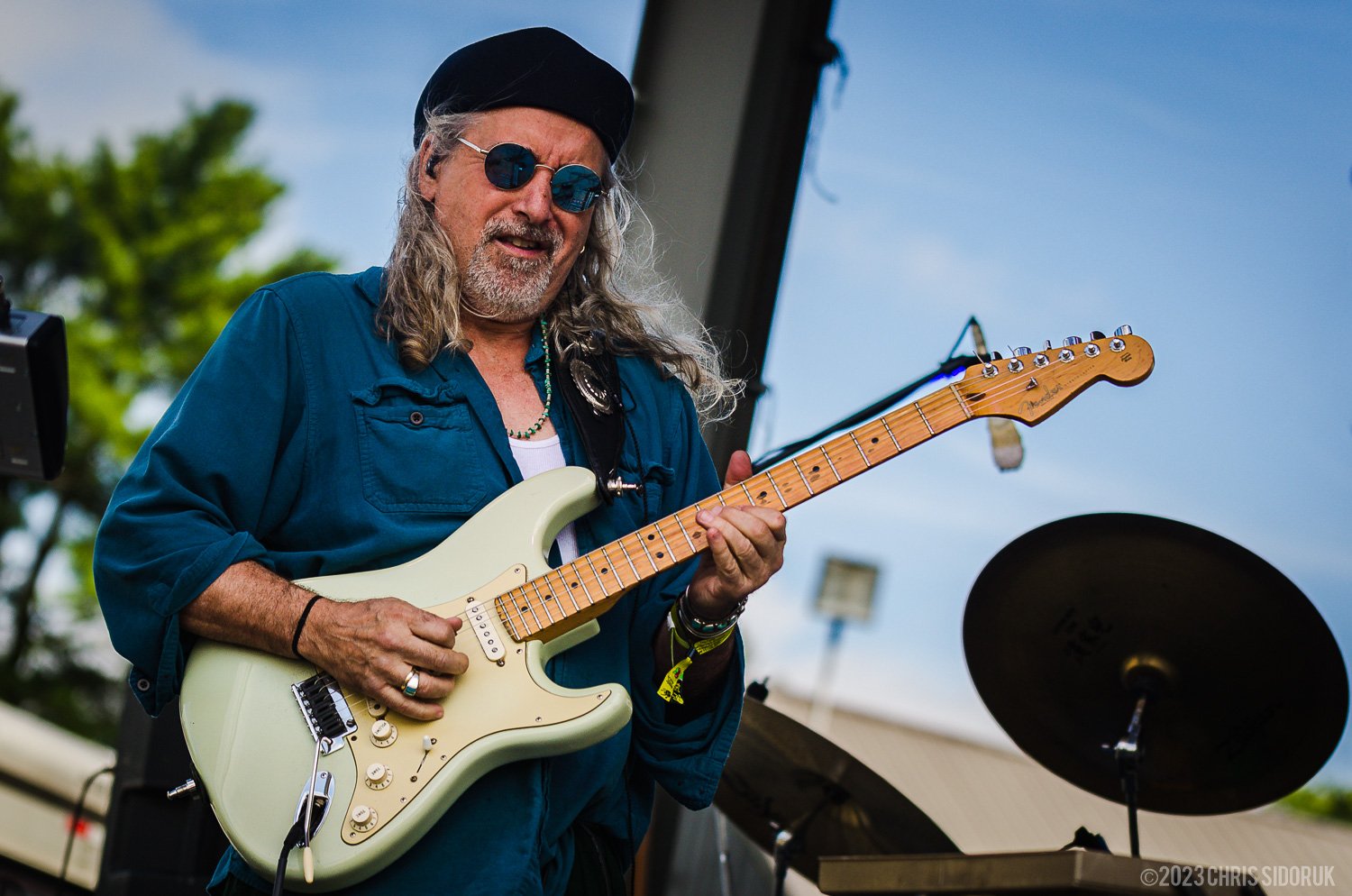
Jim Kader of Creamery Station | photo- ©2023 Chris Sidoruk
Best Concert Photography Lenses by Camera Brand (2026)
The best concert photography lens depends heavily on the camera system you use.
Canon, Nikon, and Sony all offer excellent professional glass, and third-party manufacturers like Sigma and Tamron provide strong alternatives.
The most important thing is not owning the most expensive lens.
It is building a lens kit that matches:
Your camera body
Your venues
Your shooting position
Your style of photography
Best Sony Lenses for Concert Photography
Sony has become one of the most popular systems among professional event and concert photographers because of:
Excellent autofocus performance
Strong low-light sensors
Large mirrorless lens selection
Reliable tracking performance
Sony FE 24–70mm f/2.8 GM II
Best Overall Sony Concert Lens
This is one of the strongest all-around lenses for Sony shooters.
Why it works:
Extremely sharp
Fast autofocus
Professional build quality
Compact compared with previous versions
Best for:
Clubs
Theaters
Photo pits
General concert coverage
Sony FE 70–200mm f/2.8 GM OSS II
Best Sony Festival Lens
A professional telephoto zoom designed for demanding environments.
Why it works:
Excellent reach
Fast autofocus
Strong subject separation
Professional reliability
Best for:
Festivals
Larger venues
Shooting from farther distances
Sony FE 85mm f/1.8
Best Budget Sony Portrait Lens
A lightweight prime that delivers excellent results.
Best for:
Vocalist portraits
Emotional performance moments
Low-light venues
Sony FE 50mm f/1.8
Best Budget Sony Low-Light Lens
An affordable way to dramatically improve low-light performance.
Great for:
Beginners
Small clubs
Dark stages
Best Canon Lenses for Concert Photography
Canon has long been popular among professional photographers because of:
Excellent autofocus
Strong lens quality
Reliable color rendering
Professional durability
Canon RF 24–70mm f/2.8 L IS USM
Best Overall Canon Concert Lens
A professional standard zoom for Canon mirrorless systems.
Strengths:
Excellent sharpness
Fast autofocus
Image stabilization
Versatile focal range
Best for:
General concert coverage
Event photography
Photo pits
Canon RF 70–200mm f/2.8 L IS USM
Best Canon Festival Lens
A powerful telephoto zoom with a compact professional design.
Strengths:
Excellent autofocus
Strong stabilization
Great compression
High image quality
Best for:
Large stages
Outdoor festivals
Distance shooting
Canon RF 85mm f/1.2 L USM
Best Canon Low-Light Portrait Lens
A premium prime designed for maximum subject separation.
Best for:
Artist portraits
Dramatic stage images
Low-light performance
The tradeoff:
Expensive
Large
Heavy
Canon RF 50mm f/1.8 STM
Best Budget Canon Concert Lens
A compact and affordable prime.
Great first upgrade for photographers moving beyond kit lenses.
Best Nikon Lenses for Concert Photography
Nikon has a long history in professional photography, and the Z system provides excellent options for live music.
Nikon lenses are especially known for:
Optical quality
Strong detail retention
Professional build quality
Nikon NIKKOR Z 24–70mm f/2.8 S II
Best Overall Nikon Concert Lens
A professional standard zoom designed for demanding photographers.
Strengths:
Excellent sharpness
Fast autofocus
Reliable low-light performance
Best for:
Clubs
Theaters
Events
General concert coverage
Nikon NIKKOR Z 70–200mm f/2.8 VR S II
Best Nikon Festival Lens
One of the strongest telephoto options available.
Why photographers choose it:
Excellent sharpness
Strong autofocus
Professional durability
Best for:
Festivals
Large venues
Stage performances from a distance
Nikon NIKKOR Z 85mm f/1.8 S
Best Nikon Portrait Prime
Excellent for:
Performer portraits
Emotional moments
Low-light shooting
Nikon NIKKOR Z 50mm f/1.8 S
Best Nikon Low-Light Prime
A premium 50mm option with excellent image quality.
Best Third-Party Concert Photography Lenses
Third-party lenses have become much stronger in recent years.
For many photographers, they provide professional performance at a lower cost.
Sigma Art Series
Sigma lenses are known for:
Excellent sharpness
Wide apertures
Strong value
Popular choices:
Tamron Lenses
Tamron is especially popular for photographers who want:
Lower weight
Competitive pricing
Strong optical performance
Popular choices:
Best Lens Setup Based on Venue Type
The right lens depends more on your shooting environment than your camera brand.
Small Club Concerts
Recommended:
Primary Choice
24–70mm f/2.8
or
35mm / 50mm prime
Why:
You are close to performers
Space is limited
Wide environmental images matter
Ideal Setup
Two lenses:
24–70mm f/2.8
50mm f/1.8
This covers:
Full stage shots
Performer portraits
Dark lighting situations
Medium Venues
Recommended:
24–70mm f/2.8
70–200mm f/2.8
85mm prime
Why:
You have enough distance for longer lenses but still need flexibility.
Festivals and Outdoor Shows
Recommended:
24–70mm f/2.8
70–200mm f/2.8
Optional:
100–400mm lens
Why:
Festival photography creates the biggest distance challenges.
The performer may be:
Far across the stage
Moving quickly
Surrounded by complex lighting
Best One-Lens Concert Photography Setup
If you can only bring one lens:
Choose the 24–70mm f/2.8
It gives you:
Wide shots
Medium compositions
Performer images
Fast response time
It is the lens most likely to help you avoid missed moments.
Best Two-Lens Concert Photography Setup
For most serious concert photographers:
Lens One
24–70mm f/2.8
For:
General coverage
Stage context
Close performers
Lens Two
70–200mm f/2.8
For:
Tight portraits
Distance
Festivals
This combination covers the majority of professional concert situations.
Best Three-Lens Concert Photography Setup
For photographers who regularly cover live music:
24–70mm f/2.8
The workhorse.
70–200mm f/2.8
The reach lens.
50mm or 85mm Prime
The low-light and portrait specialist.
My Recommended Concert Photography Kit
After photographing live performances in a variety of venues, I would prioritize a practical setup over simply collecting lenses.
A strong professional kit would look like:
Everyday Concert Coverage
24–70mm f/2.8
Larger Venues and Festivals
70–200mm f/2.8
Dark Clubs and Creative Portraits
50mm f/1.8
or85mm f/1.8
This gives you:
Flexibility
Low-light capability
Professional image quality
Coverage for most situations
Common Mistakes When Buying Concert Photography Lenses
Mistake 1: Buying Reach Before Solving Low Light
Many photographers immediately buy the longest lens possible.
However, if you primarily photograph:
Small clubs
Local bands
Indoor venues
a fast standard lens will often help more.
Mistake 2: Buying Too Many Lenses Too Quickly
A large collection does not automatically improve your photography.
Learning one lens deeply often produces better results.
A strong progression:
50mm f/1.8
24–70mm f/2.8
70–200mm f/2.8
Mistake 3: Ignoring Weight
Professional lenses are heavy.
A 70–200mm f/2.8 may produce incredible images, but carrying it for an entire festival day can be exhausting.
Consider:
Your shooting style
Event length
Travel requirements
Mistake 4: Choosing Sharpness Over Usability
The sharpest lens is not always the best concert lens.
A great concert lens needs:
Fast autofocus
Reliable exposure
Comfortable handling
Strong low-light performance
A lens that gets the shot beats a lens that wins laboratory tests.
How to Choose the Right Concert Photography Lens
If you simplify the decision:
Photograph Mostly Clubs?
Choose:
35mm prime
50mm prime
24–70mm f/2.8
Photograph Mixed Venues?
Choose:
24–70mm f/2.8
70–200mm f/2.8
Photograph Festivals?
Choose:
24–70mm f/2.8
70–200mm f/2.8
Want Maximum Low-Light Performance?
Choose:
35mm f/1.4
50mm f/1.4 or f/1.8
85mm f/1.8
Final Thoughts
The best concert photography lens is not always the most expensive lens.
It is the lens that allows you to consistently capture the moments that matter.
For most photographers:
The 24–70mm f/2.8 is the best first professional concert lens.
It provides the flexibility needed for unpredictable live performances.
For larger stages:
The 70–200mm f/2.8 is the essential companion.
For challenging lighting:
Fast primes like the 35mm, 50mm, and 85mm give you creative options that zoom lenses cannot match.
A great concert photography kit is built around versatility, reliability, and knowing your shooting environment.
The goal is not to carry every lens.
The goal is to have the right lens ready when the moment happens.
Frequently Asked Questions About Concert Photography Lenses
What is the best lens for concert photography?
The best overall lens for concert photography is the 24–70mm f/2.8.
It provides the flexibility needed for most live music environments, including:
Small clubs
Theaters
Medium-sized venues
Photo pit shooting
The 24–70mm range allows photographers to capture:
Full-stage compositions
Individual performers
Close-up moments
Environmental images
For extremely dark venues, a fast prime lens like a:
35mm f/1.4
50mm f/1.8
85mm f/1.8
can provide additional low-light capability.
Is f/2.8 good enough for concert photography?
Yes.
An f/2.8 aperture is considered the professional standard for concert photography zoom lenses.
Many professional photographers rely on:
24–70mm f/2.8
70–200mm f/2.8
because they provide the best combination of:
Light gathering ability
Autofocus performance
Zoom flexibility
However, extremely dark venues may benefit from faster primes at:
f/1.8
f/1.4
f/1.2
Are prime lenses better than zoom lenses for concert photography?
Neither is always better.
They solve different problems.
Prime lenses are better for:
Extremely low light
Creative portraits
Maximum background separation
Lightweight setups
Zoom lenses are better for:
Fast composition changes
Unpredictable performers
Multiple shooting positions
Professional event coverage
Many experienced concert photographers use both.
A common professional combination is:
24–70mm f/2.8
70–200mm f/2.8
50mm or 85mm prime
What focal length is best for concert photography?
The best focal length depends on your distance from the stage.
24–35mm
Best for:
Full-stage images
Crowd shots
Venue atmosphere
Environmental storytelling
50mm
Best for:
Natural perspective
Performer portraits
Small venues
85mm
Best for:
Tight portraits
Emotional moments
Subject isolation
70–200mm
Best for:
Large venues
Festivals
Distant performers
What is the best beginner lens for concert photography?
The 50mm f/1.8 is one of the best beginner concert photography lenses.
It offers:
Excellent low-light performance
Affordable pricing
Strong image quality
Easy learning curve
It is often the first lens upgrade photographers make after a basic kit lens.
Do I need an expensive lens for concert photography?
No.
Expensive professional lenses provide advantages, but great concert photography is still possible with affordable equipment.
Good budget choices include:
50mm f/1.8
Tamron 28–75mm f/2.8
Sigma 24–70mm f/2.8
The photographer’s ability to understand:
Lighting
Timing
Composition
Exposure
often matters more than owning the most expensive glass.
Is a 70–200mm lens good for concert photography?
Yes.
The 70–200mm f/2.8 is one of the most important lenses for professional concert photographers.
It is especially useful when:
You cannot get close to the stage
Shooting festivals
Photographing large venues
Working from the back of a photo pit
Its biggest advantage is creating:
Tight performer portraits
Strong background compression
Professional-looking images from a distance
Is a 24–70mm lens enough for concert photography?
For many photographers, yes.
A 24–70mm f/2.8 can handle the majority of concert situations.
It is especially effective for:
Local bands
Clubs
Theater performances
Small and medium venues
The main limitation is reach.
If you frequently photograph larger stages, adding a:
70–200mm f/2.8
will significantly expand your capabilities.
What lens aperture is best for concert photography?
The best aperture depends on the venue.
Common choices:
f/2.8
Best for:
Professional zoom lenses
General concert coverage
f/1.8–f/1.4
Best for:
Dark clubs
Creative portraits
Extremely low-light situations
A wider aperture allows faster shutter speeds and lower ISO settings.
Should I use image stabilization for concert photography?
Image stabilization can help, but it is not the most important feature.
Concert photographers usually need to freeze:
Performer movement
Guitar motion
Drummer movement
Stage action
A fast shutter speed matters more than stabilization.
Prioritize:
Autofocus speed
Aperture
Focal length
Handling
before worrying about stabilization.
What lenses do professional concert photographers use?
Many professional concert photographers rely on a combination of:
Standard Zoom
24–70mm f/2.8
Telephoto Zoom
70–200mm f/2.8
Fast Prime
35mm, 50mm, or 85mm
This setup covers:
Clubs
Theaters
Festivals
Touring productions
How many lenses should a concert photographer bring?
For most concerts, two lenses are enough.
Recommended:
24–70mm f/2.8
70–200mm f/2.8
For darker venues or creative work, add:
50mm f/1.8
or85mm f/1.8
More lenses do not always mean better photos.
A smaller, efficient kit often allows photographers to move faster and focus on the performance.
==========
Related Concert Photography Resources
Continue building your live music photography skills with these related guides:
Best Cameras for Concert Photography
Choosing the right camera body is just as important as choosing the right lens.
A strong concert camera should provide:
Reliable autofocus
Good high ISO performance
Fast burst shooting
Strong low-light capability
Best Camera Settings for Concert Photography
Learn how to balance:
Shutter speed
Aperture
ISO
Autofocus settings
for challenging stage lighting.
Concert Photography Composition Guide
Technical gear only gets you so far.
Strong composition helps transform technically sharp images into memorable photographs.
Music Festival Photography Guide
Festival environments create different challenges:
Long distances
Changing light
Multiple stages
Large crowds
Part of the Photography Gear Buying Guide Series
This article is part of the broader:
covering:
Cameras
Lenses
Computers
Storage
Editing equipment
Accessories
Explore the complete photography gear guide to compare recommendations across your entire workflow.
==========
Concert images © Chris Sidoruk. No use, copying, or redistribution without license.
Explore more:
