

Best Budget Cameras for Concert Photography (2026 Guide)
*Some links in this guide are affiliate links. If you purchase through them, it helps support my work at no extra cost to you.
==========
Last Updated: 07/23/2026
Quick Jump
- Quick Picks
- Budget Concert Camera Comparison
- What Makes a Good Budget Concert Camera?
- What to Expect From Budget Gear
- Best Budget Cameras for Concert Photography
- Best Used Cameras for Concert Photography
- Full-Frame vs APS-C for Concert Photography
- Why Lenses Matter More Than the Camera
- Best Budget Camera Setup Recommendations
- When to Upgrade Your Camera
- Common Buying Mistakes
- Final Thoughts
- Frequently Asked Questions
Concert photography is one of the most demanding genres of photography.
Dark venues, unpredictable lighting, fast-moving performers, and limited shooting opportunities push camera equipment harder than many other types of photography.
That does not mean you need a $3,000 flagship camera to get started.
A well-chosen budget camera paired with the right lens can produce excellent concert images—especially in smaller venues, local shows, clubs, and emerging artist performances.
The key is choosing gear that performs well where it matters most:
reliable autofocus in difficult lighting
usable high ISO performance
compatibility with fast lenses
comfortable handling during long shows
enough performance to capture decisive moments
This guide focuses on the best budget cameras for concert photography in 2026, including affordable full-frame and APS-C options that deliver strong real-world results without requiring a professional-level investment.
These recommendations are designed for:
photographers shooting their first concerts
local band and small venue photographers
beginners upgrading from entry-level cameras
creators building their first interchangeable lens setup
One important thing to remember:
The camera body is only part of the equation.
In concert photography, a less expensive camera paired with a fast lens often performs better than an expensive camera using a slow kit lens.
If you're building a complete affordable setup, start here:
👉 Best Budget Gear for Concert Photography
Looking for the strongest overall options regardless of budget?
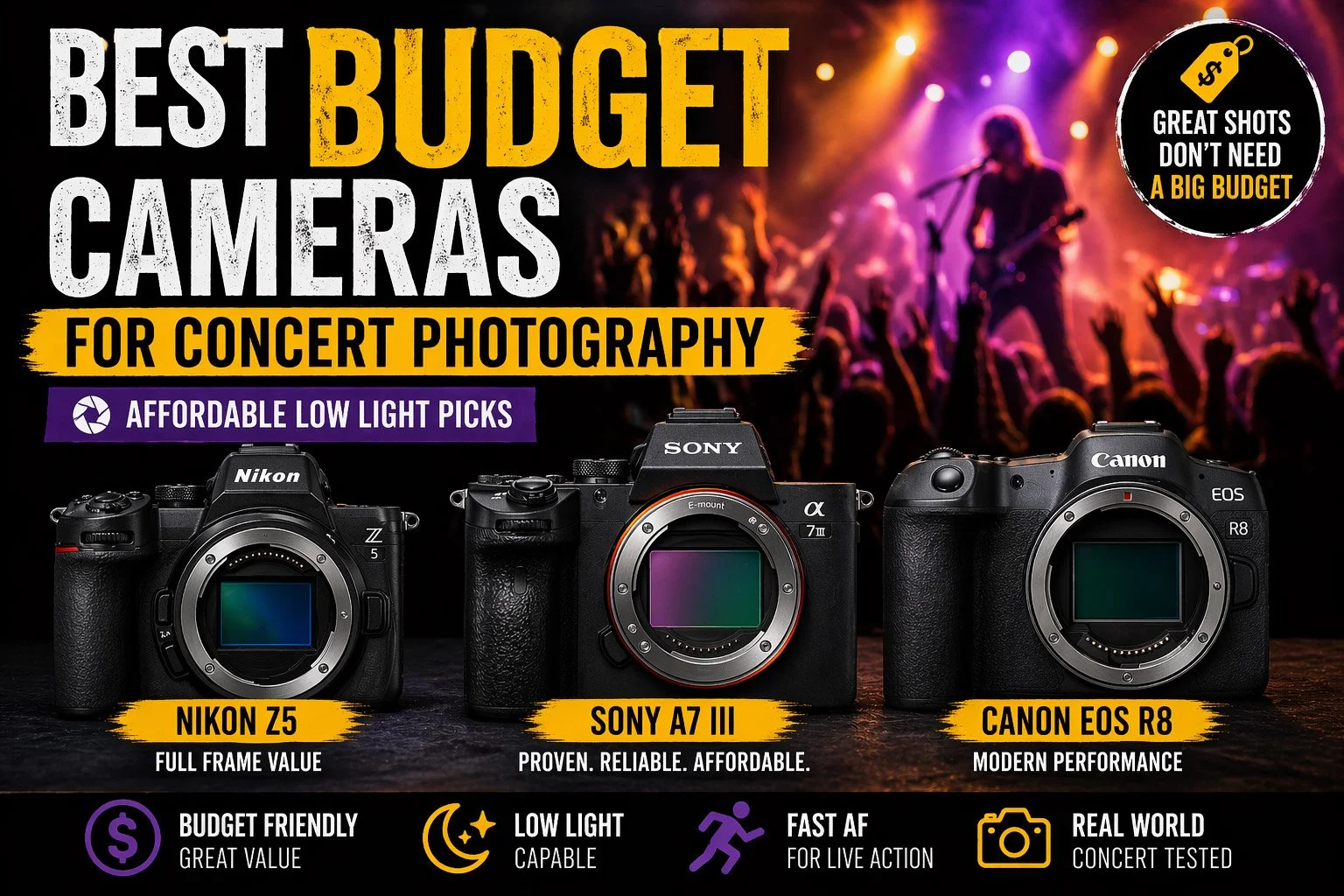
Quick Picks: Best Budget Concert Cameras in 2026
If you want the short answer, these are the budget cameras worth considering.
Best Overall Budget Value
Nikon Z5
A full-frame camera offering excellent image quality at a relatively affordable price.
Best for:
photographers wanting full-frame performance
smaller venues
still photography-focused shooters
Best Used Budget Camera
Sony A7 III
One of the best value full-frame cameras available on the used market.
Best for:
excellent autofocus
low-light concert photography
photographers building a Sony system
Best Modern Budget Full-Frame Camera
Canon EOS R8
A lightweight full-frame option with excellent autofocus and modern Canon performance.
Best for:
beginners entering the Canon RF system
hybrid shooters
photographers who want newer technology
Best Beginner Budget Camera
Canon EOS R50
An affordable APS-C camera with impressive autofocus and image quality.
Best for:
first-time concert photographers
tight budgets
smaller venues
Best Used Upgrade Value
Nikon Z6
A previous-generation full-frame camera that offers professional-level performance at a reduced price.
Best for:
photographers buying used
advanced beginners
shooters wanting more room to grow
Budget Concert Camera Comparison Table (2026)
| Camera | Sensor | Best For | Strengths | Limitations |
|---|---|---|---|---|
| Nikon Z5 | Full Frame | Best overall value | Excellent image quality, affordable full-frame | Slower autofocus, lower burst speed |
| Sony A7 III | Full Frame | Best used option | Great low light, strong autofocus, huge lens selection | Older technology |
| Canon EOS R8 | Full Frame | Best modern budget option | Excellent autofocus, lightweight, strong image quality | Smaller battery, single card slot |
| Canon EOS R50 | APS-C | Beginners | Affordable, excellent autofocus, compact | Less low-light flexibility |
| Nikon Z6 (Used) | Full Frame | Used upgrade | Professional handling, strong image quality | Older autofocus system |
| Sony a6100/a6400 | APS-C | Tight budgets | Affordable, good autofocus | Smaller sensor, less low-light ability |
Nikon Z5
Sensor: Full Frame
Best For: Best overall value
Strengths: Excellent image quality, affordable full-frame
Limitations: Slower autofocus, lower burst speed
Sony A7 III
Sensor: Full Frame
Best For: Best used option
Strengths: Great low light, strong autofocus, huge lens selection
Limitations: Older technology
Canon EOS R8
Sensor: Full Frame
Best For: Best modern budget option
Strengths: Excellent autofocus, lightweight, strong image quality
Limitations: Smaller battery, single card slot
Canon EOS R50
Sensor: APS-C
Best For: Beginners
Strengths: Affordable, excellent autofocus, compact
Limitations: Less low-light flexibility
Nikon Z6 (Used)
Sensor: Full Frame
Best For: Used upgrade
Strengths: Professional handling, strong image quality
Limitations: Older autofocus system
Sony a6100/a6400
Sensor: APS-C
Best For: Tight budgets
Strengths: Affordable, good autofocus
Limitations: Smaller sensor, less low-light ability
What Makes a Good Budget Camera for Concert Photography?
Not every inexpensive camera is a good concert camera.
Live music photography creates challenges that expose the weaknesses of entry-level equipment quickly.
A good budget concert camera should prioritize real-world performance over marketing features.
Here are the areas that matter most.
1. High ISO Performance
Concert venues are often dark.
You may be shooting under:
colored stage lights
inconsistent exposure
rapidly changing brightness
minimal available light
A camera with good high ISO performance allows you to maintain faster shutter speeds without producing unusable noise.
For concert photography, a sharp photo with some noise is almost always better than a clean but blurry image.
Full-frame cameras generally have an advantage here, but modern APS-C cameras can still perform well with the right lens.
2. Autofocus Reliability
Concert photography gives you very little room for error.
Performers move constantly, lighting changes quickly, and important moments happen instantly.
A good budget camera should have:
reliable continuous autofocus
face detection
eye detection when available
subject tracking
good low-light focusing ability
A camera that focuses accurately will improve your results more than a small increase in resolution.
3. Compatibility With Fast Lenses
This is one of the biggest factors beginners overlook.
A budget camera becomes far more capable when paired with a fast lens.
Look for compatibility with lenses such as:
50mm f/1.8
35mm f/1.8
85mm f/1.8
These lenses allow more light into the camera and help create cleaner images in dark venues.
A $700 camera with a fast prime lens can often outperform a $2,000 camera with a slow kit lens.
4. Burst Shooting and Buffer Performance
Concerts move quickly.
You may only have a few seconds to capture:
a singer's expression
a guitarist's movement
a dramatic lighting moment
crowd interaction
A reasonable burst rate helps increase your chances of capturing those moments.
You do not need a professional sports camera, but extremely slow cameras can become frustrating.
5. Ergonomics and Handling
Concert photographers often shoot for hours while moving around venues.
A good camera should have:
comfortable grip
accessible controls
easy ISO adjustments
reliable battery life
simple menu navigation
A camera that feels natural in your hands allows you to focus more on the performance and less on settings.
6. Lens Availability and Cost
The camera system matters as much as the camera body.
Before buying, consider:
affordable fast lenses
used lens availability
future upgrade options
A cheaper camera with an expensive or limited lens ecosystem may cost more long-term.
Systems like:
Sony E-mount
Canon RF
Nikon Z
all provide strong options for photographers building a concert setup.
What You Should Expect From Budget Concert Photography Gear
A budget camera can absolutely capture great concert photos.
However, it is important to understand what you are gaining—and what compromises you are making.
Lower-cost cameras are not necessarily bad cameras.
They are simply designed with different priorities.
When buying budget gear, you may sacrifice:
advanced autofocus performance
faster burst shooting
premium build quality
larger buffers
the newest video features
professional-level weather sealing
That does not mean the camera cannot handle real concert work.
Many photographers have built strong portfolios using cameras that are now considered affordable because they focused on:
choosing the right lens
understanding exposure
learning autofocus settings
improving timing and composition
The goal is not buying the cheapest camera possible.
The goal is finding the camera that gives you the most useful performance for your budget.
Best Overall Budget Concert Camera
Nikon Z5
Best Budget Full-Frame Value
The Nikon Z5 is one of the most practical entry points into full-frame concert photography.
For photographers who want improved low-light performance without paying flagship prices, the Z5 offers a lot of value.
Its full-frame sensor provides excellent image quality, strong dynamic range, and better high ISO performance than most entry-level APS-C cameras.
For concert photography, that extra sensor size becomes especially valuable when shooting in darker venues.
Why the Nikon Z5 Works for Concert Photography
The biggest advantage of the Z5 is simple:
It gives you full-frame image quality at a lower price point.
The larger sensor helps with:
cleaner high ISO images
better low-light flexibility
improved subject separation
more editing flexibility
Paired with a fast lens such as a:
the Z5 becomes a very capable concert photography setup.
Best For
✔ Beginners moving into serious concert photography
✔ Small venues and local bands
✔ Photographers who prioritize image quality
✔ Nikon shooters looking for an affordable full-frame body
✔ Still photographers who do not need advanced video features
Strengths
✔ Full-frame sensor
✔ Excellent image quality
✔ Strong dynamic range
✔ Comfortable Nikon ergonomics
✔ Good battery life
✔ Access to Nikon Z lenses
✔ Great value on the used market
Limitations
✘ Autofocus is slower than newer Nikon bodies
✘ Lower burst speed than action-focused cameras
✘ Less ideal for extremely fast performers
✘ Video features are more basic compared with newer hybrid cameras
Real-World Concert Performance
The Nikon Z5 works especially well for:
acoustic performances
smaller clubs
singer-songwriter shows
controlled lighting environments
It is less ideal for:
extremely fast performers
dark venues with unpredictable movement
situations requiring maximum autofocus tracking performance
For many beginners, though, these limitations are manageable.
Bottom Line
The Nikon Z5 is one of the smartest budget full-frame choices for photographers who want excellent image quality without spending thousands.
If your goal is learning concert photography and building a strong portfolio, it provides everything you need to get started.
👉 Check current price and availability
Best Used Budget Concert Camera
Sony A7 III
Best Used Full-Frame Value
The Sony A7 III remains one of the strongest budget concert photography cameras available.
Originally positioned as a professional-level mirrorless camera, it has become one of the best values on the used market.
Its combination of:
excellent low-light performance
reliable autofocus
strong battery life
huge lens ecosystem
makes it extremely appealing for concert photographers.
Why the Sony A7 III Works for Concert Photography
Concert photographers often prioritize three things:
autofocus reliability
high ISO performance
lens availability
The A7 III performs very well in all three categories.
Its full-frame sensor handles difficult lighting situations confidently, and Sony's autofocus system remains very capable despite newer models being more advanced.
Best For
✔ Photographers buying used gear
✔ Concert photographers shooting regularly
✔ Sony shooters building a lens collection
✔ Low-light event photography
✔ Photographers who want professional features without professional pricing
Strengths
✔ Excellent high ISO performance
✔ Strong autofocus
✔ Great battery life
✔ Dual memory card slots
✔ Huge Sony E-mount lens selection
✔ Excellent used value
Limitations
✘ Older autofocus technology compared with newer Sony cameras
✘ Lower resolution than newer models
✘ Menu system can feel dated
✘ No modern AI-based subject recognition
Real-World Concert Performance
The A7 III remains very comfortable shooting:
clubs
theaters
festivals
event photography
touring musicians
The combination of full-frame image quality and affordable fast lenses makes it one of the easiest recommendations for photographers building a serious budget setup.
Recommended Lens Pairings
Great budget combinations include:
Sony A7 III + Sony FE 50mm f/1.8
Best affordable starting setup.
Sony A7 III + Sony FE 85mm f/1.8
Great for stage isolation.
Sony A7 III + Tamron 28-75mm f/2.8
A flexible event setup.
Bottom Line
If you are comfortable buying used, the Sony A7 III is arguably one of the best value concert cameras available.
It delivers professional-level image quality at a price accessible to many beginners and enthusiasts.
👉 Check current price and availability
Best Modern Budget Full-Frame Camera
Canon EOS R8
Best Budget Canon Concert Camera
The Canon EOS R8 is one of the strongest options for photographers who want modern full-frame performance without moving into higher-priced bodies.
It combines:
excellent autofocus
impressive image quality
lightweight design
Canon's easy-to-use interface
making it a great entry point into the RF mirrorless system.
Why the Canon EOS R8 Works for Concert Photography
The R8's biggest advantage is autofocus.
Canon's Dual Pixel CMOS AF system is extremely reliable and performs well in challenging lighting.
For concert photographers, that means:
more focused images
better performer tracking
easier shooting in unpredictable conditions
Its full-frame sensor also provides strong low-light performance.
Best For
✔ Beginners entering the Canon RF system
✔ Photographers who want newer technology
✔ Concert photographers who also shoot video
✔ Travel and event photographers
✔ Lightweight setups
Strengths
✔ Excellent autofocus
✔ Strong full-frame image quality
✔ Lightweight body
✔ Great color science
✔ Strong video capability
✔ Modern Canon RF lens compatibility
Limitations
✘ Smaller battery
✘ Single memory card slot
✘ Less robust body compared with professional models
✘ No in-body image stabilization
Real-World Concert Performance
The EOS R8 is especially strong for:
small venues
club photography
hybrid photo/video work
photographers who travel with minimal gear
Its lightweight body is also helpful when shooting long events where carrying heavy equipment becomes tiring.
Recommended Lens Pairings
Canon EOS R8 + RF 50mm f/1.8 STM
Best budget starter combination.
Canon EOS R8 + RF 35mm f/1.8 Macro IS STM
Great for smaller venues.
Canon EOS R8 + RF 85mm f/2 Macro IS STM
Good for tighter performer shots.
Bottom Line
The Canon EOS R8 offers one of the best combinations of modern autofocus, full-frame quality, and affordability.
For photographers who want a new camera rather than used equipment, it is one of the strongest budget concert options available.
👉 Check current price and availability
Best Beginner Budget Concert Camera
Canon EOS R50
Best APS-C Camera for Beginners
Not every photographer needs to start with a full-frame camera.
For beginners with a tighter budget, an APS-C camera paired with a fast lens can be an excellent way to learn concert photography without a large investment.
The Canon EOS R50 is one of the best entry-level options because it combines:
excellent autofocus
impressive image quality
lightweight design
simple controls
access to Canon's growing RF lens system
It proves that affordable cameras can still produce professional-looking results when used correctly.
Why the Canon EOS R50 Works for Concert Photography
The biggest advantage of the R50 is accessibility.
Many beginners struggle more with learning:
exposure
autofocus settings
timing
composition
than with the camera itself.
The EOS R50 removes much of the complexity while still offering enough performance to grow as a photographer.
Its autofocus system is especially impressive for the price, with reliable:
face detection
eye tracking
subject recognition
For smaller venues and well-lit stages, it can produce excellent results.
Best For
✔ First-time concert photographers
✔ Small venues
✔ Local bands
✔ Beginners learning manual settings
✔ Photographers with limited budgets
✔ Travel and everyday photography
Strengths
✔ Affordable entry point
✔ Excellent autofocus
✔ Lightweight body
✔ Easy-to-use controls
✔ Good image quality
✔ 4K video capability
✔ Access to Canon RF lenses
Limitations
✘ APS-C sensor has more limitations in very dark venues
✘ Smaller battery
✘ Single memory card slot
✘ Less professional handling
✘ Less flexibility at high ISO compared with full-frame cameras
Real-World Concert Performance
The EOS R50 works best for:
bars
small clubs
community performances
local artists
venues with decent stage lighting
The biggest improvement you can make is pairing it with a fast lens.
A:
will dramatically improve what the camera can do.
Bottom Line
The Canon EOS R50 is one of the smartest choices for photographers who are just starting out.
It is not designed to compete with professional full-frame bodies, but it provides enough capability to learn concert photography and build a portfolio.
The camera matters—but the photographer and lens matter more.
👉 Check current price and availability
Best Budget Sony APS-C Options
Sony a6100 / a6400
Sony's APS-C mirrorless cameras remain popular choices for photographers who want strong autofocus performance without spending full-frame money.
The Sony a6100 and a6400 are especially appealing because they provide access to Sony's excellent E-mount lens ecosystem.
Why Sony APS-C Cameras Work for Concert Photography
Sony has historically been one of the strongest manufacturers when it comes to autofocus technology.
Even these smaller APS-C bodies offer:
reliable eye autofocus
strong subject tracking
compact designs
access to affordable fast lenses
For beginners, the ability to buy inexpensive lenses is a major advantage.
Best For
✔ Budget-conscious photographers
✔ Beginners entering mirrorless photography
✔ Travel photographers
✔ Smaller venues
✔ Creators who value portability
Strengths
✔ Excellent autofocus
✔ Large lens ecosystem
✔ Affordable used prices
✔ Compact bodies
✔ Good image quality
✔ Strong third-party lens support
Limitations
✘ APS-C sensor limitations in very dark venues
✘ Smaller grip on some models
✘ Less professional handling
✘ Lower battery capacity compared with larger bodies
Recommended Lens Pairings
Sony a6100/a6400 + Sigma 30mm f/1.4 DC DN
Great low-light option for smaller venues.
Sony a6100/a6400 + Sony 50mm f/1.8 OSS
Affordable stage photography setup.
Sony a6400 + Sigma 18-50mm f/2.8
Flexible event setup.
Bottom Line
Sony APS-C cameras are excellent starting points because they combine:
affordable bodies
strong autofocus
inexpensive lenses
For photographers who are unsure whether concert photography will become a serious pursuit, they offer a low-risk entry point.
Best Used Budget Cameras for Concert Photography
Buying used is often one of the smartest ways to build a concert photography setup.
Instead of purchasing a brand-new entry-level camera, you can often find older professional or enthusiast bodies that offer:
better ergonomics
stronger build quality
improved controls
better low-light performance
Sony A7 II (Used)
The Sony A7 II can still be a capable entry point into full-frame photography.
Strengths
✔ Full-frame sensor
✔ Affordable used pricing
✔ In-body image stabilization
✔ Access to Sony lenses
Limitations
✘ Older autofocus system
✘ Lower battery life
✘ Slower performance
Best For
Photographers who want full-frame quality at the lowest possible price.
Nikon Z6 (Used)
The Nikon Z6 is a significant step above many entry-level cameras.
It offers:
excellent image quality
strong low-light performance
professional handling
in-body stabilization
Strengths
✔ Full-frame sensor
✔ Excellent ergonomics
✔ Strong high ISO performance
✔ Professional controls
Limitations
✘ Older autofocus compared with newer cameras
✘ Smaller lens selection than Sony
Best For
Photographers who want a professional-feeling camera without paying new-body prices.
Canon EOS RP (Used)
The Canon EOS RP remains another affordable full-frame option for photographers entering the Canon RF system.
Strengths
✔ Full-frame image quality
✔ Lightweight body
✔ Access to RF lenses
✔ Affordable used market
Limitations
✘ Older autofocus system
✘ Lower burst performance
✘ Limited battery life
Best For
Photographers prioritizing image quality and Canon compatibility.
Full-Frame vs APS-C for Concert Photography
One of the biggest decisions budget photographers face is whether to buy a full-frame or APS-C camera.
The answer depends on your budget, venue type, and long-term goals.
Full-Frame Cameras
Examples:
Advantages
Better Low-Light Performance
Concert venues are often dark.
Full-frame sensors generally provide:
cleaner high ISO images
better shadow recovery
more flexibility in difficult lighting
Better Depth of Field Control
Full-frame cameras make it easier to create:
blurred backgrounds
isolated performers
professional-looking images
More Room to Grow
If you plan to photograph:
touring musicians
larger venues
paid assignments
professional events
full-frame provides more flexibility.
Disadvantages
✘ Higher camera cost
✘ More expensive lenses
✘ Larger overall system
APS-C Cameras
Examples:
Advantages
Lower Cost
APS-C systems allow you to spend more money on the lens.
This is important because a fast lens often improves results more than upgrading the camera.
Smaller and Lighter
A compact setup is easier to carry through:
crowded venues
festivals
long events
Great for Learning
APS-C cameras are more than capable of teaching:
exposure
autofocus
composition
timing
Disadvantages
✘ More noise at higher ISO
✘ Less flexibility in extremely dark venues
✘ Smaller lens options for professional workflows
Which Should You Buy?
Choose Full-Frame If:
✔ You regularly photograph concerts
✔ You shoot in dark venues
✔ You want professional results
✔ You plan to grow into paid work
✔ You can afford quality lenses
Choose APS-C If:
✔ You are just starting
✔ Your budget is limited
✔ You photograph smaller venues
✔ You want a lightweight setup
✔ You are still learning concert photography
Final Recommendation
For most serious concert photographers, full-frame remains the better long-term investment.
However, a beginner with an APS-C camera and a fast prime lens can absolutely create excellent concert images.
The biggest mistake is buying an expensive camera and pairing it with a slow lens.
A simple setup like:
or
will take you much further than many beginners realize.
Why Lenses Matter More Than the Camera Body
One of the biggest mistakes beginner concert photographers make is spending their entire budget on the camera body and leaving very little for lenses.
In live music photography, the lens often has a bigger impact on your results than the camera itself.
A budget full-frame camera with a fast lens will usually outperform a more expensive camera paired with a slow kit lens.
Concert environments are challenging because you are dealing with:
dim stage lighting
fast-moving performers
changing colors and contrast
limited shooting positions
moments that cannot be recreated
A fast lens gives your camera more light to work with, which helps you:
use faster shutter speeds
keep ISO lower
freeze performer movement
create cleaner images
separate subjects from distracting backgrounds
For concert photography, prioritize:
wider apertures (f/1.8–f/2.8)
reliable autofocus
useful focal lengths
lightweight designs you can comfortably carry
Best Budget Concert Photography Lenses
50mm f/1.8 — Best First Concert Lens
A 50mm f/1.8 is one of the smartest first purchases for almost any beginner concert photographer.
Why it works:
✔ Extremely affordable
✔ Excellent low-light performance
✔ Sharp image quality
✔ Lightweight
✔ Works well in small venues
The wide f/1.8 aperture allows significantly more light compared to typical kit lenses, making it much easier to photograph performers under difficult stage lighting.
A 50mm lens is especially useful for:
smaller clubs
local bands
vocalist portraits
drummer and guitarist shots
tighter stage compositions
For photographers building their first setup, this is usually the lens I recommend buying before upgrading the camera body.
35mm f/1.8 — Best Small Venue Lens
A 35mm f/1.8 provides a wider perspective than a 50mm while maintaining excellent low-light capability.
Why it works:
✔ Better for cramped venues
✔ Captures more of the stage environment
✔ Easier framing when you are close to performers
✔ Still excellent in low light
A 35mm lens is ideal for:
bars
clubs
small stages
documentary-style concert photography
environmental portraits
If you frequently shoot from the crowd or close to the stage, a 35mm can often be more useful than a 50mm.
85mm f/1.8 — Best for Stage Isolation
An 85mm f/1.8 is the choice when you want stronger subject separation and tighter performer images.
Why it works:
✔ Beautiful background blur
✔ Excellent performer isolation
✔ Great for portraits from farther away
✔ Strong low-light ability
Best uses:
larger stages
photographing singers and musicians from a distance
isolating performers from distracting backgrounds
The limitation is that 85mm can feel too tight in very small venues.
Budget Zoom Lens Options
Prime lenses are usually the best value for concert photography, but zoom lenses can still be useful.
24–70mm f/4
A 24–70mm f/4 provides flexibility when you need to quickly change compositions.
Advantages:
✔ Multiple focal lengths in one lens
✔ Useful for events and mixed assignments
✔ Less lens swapping
Limitations:
✘ Lets in less light than f/2.8 zooms
✘ Requires higher ISO settings
✘ Less ideal for very dark venues
A 24–70mm f/4 works best when:
venues have decent lighting
you need flexibility
you also photograph events outside concerts
24–70mm f/2.8 (Long-Term Upgrade)
Eventually, many concert photographers move toward a 24–70mm f/2.8.
It provides:
professional flexibility
excellent low-light performance
wider framing options
faster autofocus
However, it is usually not the first purchase I recommend for beginners because the cost is significantly higher.
A fast prime lens often gives better results for less money when starting out.
Recommended Budget Concert Photography Setups
The best setup depends on your budget, but these combinations provide a realistic starting point.
Under $700 Setup — Maximum Value Beginner Kit
Camera:
Canon EOS R50 (used or discounted)
Lens:
50mm f/1.8
Accessories:
extra battery
quality memory card
Why this works:
This setup keeps costs low while still providing:
✔ modern autofocus
✔ excellent image quality
✔ strong low-light capability with the prime lens
✔ lightweight portability
This is a great starting point for:
first concerts
local bands
small venues
learning photography fundamentals
Around $1,000 Setup — Best Beginner Full-Frame Value
Camera:
Lens:
Accessories:
spare battery
reliable SD cards
basic camera bag
Why this works:
The Sony A7 III remains popular because it combines:
✔ excellent full-frame image quality
✔ strong autofocus
✔ impressive high ISO performance
✔ huge lens selection
This setup gives beginners a serious upgrade path without spending professional-level money.
Around $1,500 Setup — Strong Long-Term Starter Kit
Camera:
Lens:
35mm f/1.8 or 50mm f/1.8
Accessories:
two batteries
multiple memory cards
comfortable camera strap
Why this works:
This setup gives you:
✔ full-frame image quality
✔ better low-light flexibility
✔ modern autofocus
✔ room to grow into more advanced work
For photographers who know they want to continue shooting concerts, this is often the better investment.
Small Venue Reality: Budget Gear Can Actually Be an Advantage
Many photographers assume they need expensive equipment before shooting concerts.
That is not true.
Small venues are where many successful concert photographers learn the fundamentals.
Smaller shows teach you:
how to work with unpredictable lighting
how to anticipate performer movement
how to find better angles
how to make creative compositions
how to maximize limited gear
A $1,000 setup used correctly can produce stronger images than a $5,000 setup used without understanding exposure and timing.
The biggest advantages in small venues often come from:
knowing where to stand
understanding the lighting pattern
anticipating moments
choosing the right settings
Gear helps, but experience creates the image.
The Best Budget Strategy
If you are starting from scratch, prioritize your purchases in this order:
1. Fast Lens
A quality f/1.8 prime will immediately improve your concert photography.
2. Capable Camera Body
Choose a body with:
good autofocus
acceptable high ISO performance
reliable operation
3. Essential Accessories
Invest in:
batteries
memory cards
storage backups
4. Upgrade Later
Once your current setup is limiting your work, then consider:
better camera body
professional zoom lenses
additional focal lengths
The goal is not owning expensive gear.
The goal is building a setup that helps you consistently capture the moment.
When to Upgrade From a Budget Concert Camera
A budget camera can take you much further than many photographers expect.
The right question is not:
“Is my camera good enough?”
The better question is:
“Is my camera limiting the results I am trying to achieve?”
Many photographers upgrade too early because they believe better gear automatically creates better photos.
In reality, upgrading makes the most sense when your current equipment is preventing you from doing the work you want to do.
Signs It May Be Time to Upgrade
Autofocus Is Missing Important Moments
Concert photography moves quickly.
If your camera consistently struggles to:
lock onto performers
track moving subjects
focus in changing stage lighting
then a newer camera body may improve your results.
Modern autofocus systems are one of the biggest improvements between older budget cameras and newer models.
Low-Light Performance Is Holding You Back
Budget cameras can perform well, but there are limits.
You may benefit from upgrading if you frequently find yourself:
pushing ISO too high
losing image quality in dark venues
unable to maintain fast shutter speeds
struggling with noisy files
A newer full-frame camera can provide more flexibility in difficult lighting.
You Are Shooting More Frequently
A camera that works for occasional shows may not be the best choice once photography becomes a regular commitment.
Consider upgrading if:
you photograph multiple shows per month
bands depend on your work
you are licensing images
photography is becoming a business
Reliability becomes more important when missed shots have financial consequences.
Your Current Camera Limits Your Creativity
Sometimes the limitation is not image quality—it is flexibility.
You may want to upgrade when you need:
better autofocus tracking
faster burst shooting
better ergonomics
improved battery life
dual card slots
stronger weather sealing
These features become more valuable as you gain experience.
What You Should Upgrade First
For most concert photographers, the upgrade path should usually be:
1. Upgrade the Lens First
A better lens often creates the biggest improvement.
Moving from a kit lens to:
50mm f/1.8
35mm f/1.8
85mm f/1.8
can dramatically improve low-light performance.
2. Improve Your Camera Body
Once your lens setup is strong, upgrade the camera if you are hitting limitations.
Examples:
older autofocus systems
poor high ISO performance
weak battery life
limited video features
3. Expand Your Lens Collection
Many experienced concert photographers eventually build around:
a fast wide lens
a standard zoom
a telephoto lens
The right lenses often stay with you through multiple camera upgrades.
Common Budget Camera Buying Mistakes
Spending Everything on the Camera Body
This is probably the most common beginner mistake.
A $1,500 camera with a slow kit lens may struggle more in concerts than a $700 camera paired with a fast prime lens.
For live music, the lens is a major part of your low-light performance.
Buying Based Only on Megapixels
More megapixels do not automatically create better concert photos.
Important factors include:
autofocus performance
ISO performance
lens availability
handling
reliability
A lower-resolution camera with excellent autofocus can outperform a higher-resolution camera in real concert conditions.
Ignoring Lens Costs
The camera body is only the beginning.
Before buying a camera, consider:
fast lenses
batteries
memory cards
storage
accessories
A camera system is an investment, not just a single purchase.
Buying the Wrong Camera System
Switching systems later can become expensive.
Before choosing a camera, consider:
available lenses
used market options
future upgrade paths
your photography goals
Canon RF, Sony E, Nikon Z, Fujifilm X, and other systems all have strengths.
Choose the system that fits where you want to go.
Buying Too Much Camera Too Soon
Many beginners buy professional-level cameras before developing the skills needed to use them.
A flagship camera will not automatically improve:
composition
timing
positioning
exposure decisions
A less expensive camera used well will always outperform expensive equipment used poorly.
Forgetting About Storage
Concert photography creates a lot of files.
A single show can generate:
hundreds of RAW images
large editing catalogs
multiple backups
Remember to budget for:
memory cards
external drives
backup systems
Final Thoughts
You do not need a $3,000 camera to start shooting concerts.
A capable budget camera paired with the right lens can produce professional-looking results in real-world venues.
The most important priorities are:
Choose a camera with reliable autofocus and acceptable low-light performance
Invest in a fast lens
Learn your settings and understand exposure
Practice in real venues
The Nikon Z5, Sony A7 III, Canon EOS R8, Canon EOS R50, and similar cameras all prove that getting started does not require a huge investment.
The best camera is not the one with the highest price tag.
It is the one that allows you to consistently capture the moments that matter.
Frequently Asked Questions
What is the best budget camera for concert photography?
The best budget concert camera depends on your system preference and budget.
The Sony A7 III is one of the strongest used-value options because of its excellent autofocus and full-frame low-light performance.
The Canon EOS R8 offers modern full-frame performance at a lower cost, while the Nikon Z5 provides excellent value for photographers who want full-frame image quality.
Can you shoot concerts with a cheap camera?
Yes.
A budget camera can produce excellent concert photos when paired with:
a fast lens
proper settings
good shooting technique
The lens choice and photographer's experience often matter more than the camera price.
Is full-frame necessary for concert photography?
No.
Full-frame cameras provide advantages in:
low-light performance
noise control
depth of field
However, APS-C cameras can still produce excellent results, especially with fast lenses like f/1.8 primes.
For beginners shooting smaller venues, APS-C can be an excellent starting point.
What lens should I buy first for budget concert photography?
A 50mm f/1.8 is usually the best first choice.
It is:
affordable
sharp
excellent in low light
versatile for many venues
A 35mm f/1.8 may be a better choice if you regularly shoot very small stages or crowded venues.
Is a used camera worth buying for concert photography?
Yes.
Used cameras can provide excellent value, especially when buying models like:
Sony A7 III
Nikon Z6
Sony A7 II
A used full-frame camera may outperform a newer entry-level camera at a similar price.
What is the cheapest camera that can shoot concerts?
Entry-level APS-C cameras such as the Canon EOS R50 or Sony a6100 can produce strong results when paired with a fast lens.
They are especially useful for:
beginners
small venues
learning concert photography fundamentals
Should I upgrade my camera or buy a better lens?
For most beginners, buy the better lens first.
A fast lens will usually make a larger difference in concert photography because it directly improves:
available light
shutter speed
subject separation
image quality
Upgrade the camera body once your current camera is genuinely limiting your results.
What camera settings should I use for concert photography?
Concert settings vary depending on lighting, but most photographers start with:
fast shutter speeds to freeze movement
wide apertures to gather light
Auto ISO or controlled higher ISO settings
continuous autofocus
burst shooting when needed
For a complete breakdown:
→ Best Camera Settings for Concert Photography
Can budget cameras shoot professional concert photos?
Yes.
Professional results come from combining:
the right equipment
knowledge of lighting
timing
composition
experience
Many photographers begin with affordable cameras and upgrade only after their work requires it.
==========
Explore more:
