

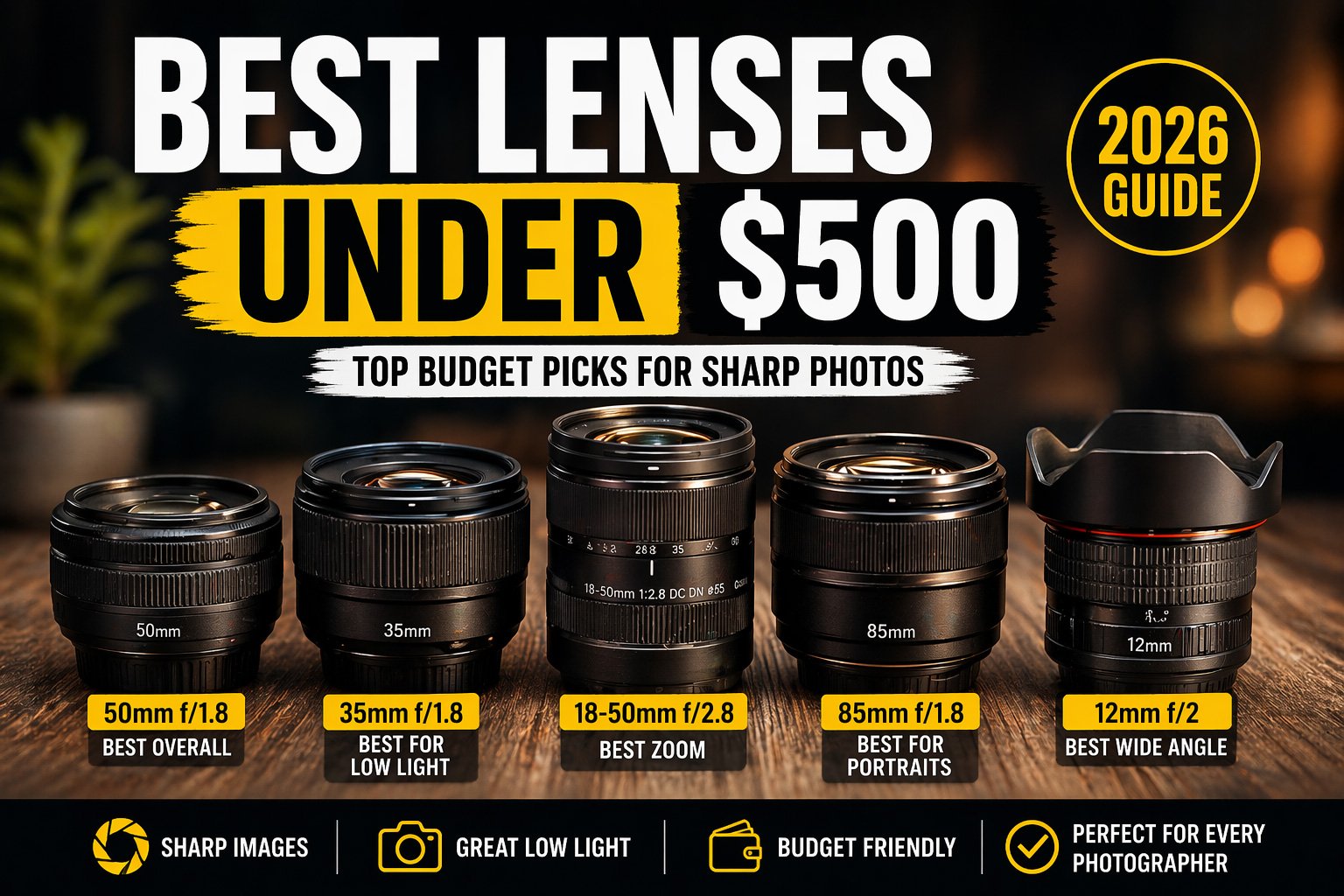
Best Lenses Under $500 (2026 Budget Buying Guide)
*Some links in this guide are affiliate links. If you purchase through them, it helps support my work at no extra cost to you.
==========
Last Updated: July 2026
Finding a great camera lens under $500 has never been easier. Thanks to fierce competition between Canon, Nikon, Sony, Fujifilm, Sigma, Tamron, Viltrox, Samyang, and other manufacturers, photographers now have access to lenses that deliver impressive image quality without requiring a professional-level budget.
In fact, upgrading your lens is often the single biggest improvement you can make to your photography. While camera bodies continue to add new features every year, a quality lens can dramatically improve sharpness, low-light performance, autofocus speed, and background blur—even if you're using an older camera.
Whether you're photographing concerts, landscapes, portraits, wildlife, travel, or everyday life, there's an affordable lens that can noticeably elevate your images.
In this guide, we'll compare the best camera lenses under $500, explain what makes each one stand out, and help you choose the right lens for your photography style.
Why Upgrade Your Lens Before Your Camera?
One of the biggest mistakes new photographers make is assuming that buying a more expensive camera will automatically produce better photos.
In reality, your lens has a greater impact on image quality than your camera body in many situations.
A better lens can provide:
noticeably sharper images
improved low-light performance
faster and more accurate autofocus
smoother background blur (bokeh)
better contrast and color rendering
stronger edge-to-edge sharpness
For example, pairing a quality prime lens with an entry-level mirrorless camera often produces better results than using an expensive camera with a basic kit lens.
Lenses also tend to remain useful much longer than camera bodies. While cameras are updated every few years, a good lens can stay in your camera bag for a decade or more.
If you're deciding between upgrading your camera or buying a better lens, the lens is often the smarter investment.
How We Chose These Lenses
Rather than simply listing the newest lenses on the market, this guide focuses on products that deliver the best real-world value for photographers shopping on a budget.
Every recommendation was selected using several criteria:
overall image quality
autofocus performance
low-light capability
build quality
value for the money
availability from major retailers
performance for its intended purpose
Whenever possible, the recommendations also consider how each lens performs in real-world photography instead of relying solely on laboratory tests or specification sheets.
Some lenses excel at portraits, while others are designed for landscapes, concerts, travel, or general everyday photography. The goal isn't to find one perfect lens—it's to help you find the right lens for the way you shoot.
What to Look for in a Lens Under $500
Shopping on a budget doesn't mean settling for poor quality. Many affordable lenses perform exceptionally well when matched to the right camera and shooting style.
Before buying, consider these factors.
Maximum Aperture
A wide maximum aperture—such as f/1.4, f/1.8, or f/2—allows more light to reach the sensor.
Benefits include:
better low-light performance
faster shutter speeds
lower ISO settings
stronger background blur
improved subject separation
For many photographers, aperture is more important than focal length when shopping under $500.
Autofocus Performance
Modern autofocus systems are remarkably capable, but the lens still plays a significant role.
A quality autofocus lens should offer:
fast focusing
accurate subject tracking
quiet operation for video
dependable performance in low light
This becomes especially important for action, wildlife, concerts, sports, and event photography.
Image Sharpness
Most modern lenses are capable of producing excellent photos, but some maintain better sharpness across the entire frame.
Pay attention to:
center sharpness
corner sharpness
contrast
chromatic aberration
distortion
Many budget prime lenses outperform much more expensive zoom lenses in pure image quality.
Build Quality
Not every photographer needs professional weather sealing, but build quality still matters.
Consider:
durable construction
weather resistance (if available)
focus ring feel
size and weight
filter compatibility
A lighter lens is often more enjoyable to carry for travel or everyday photography.
Lens Compatibility
Always verify that the lens matches your camera mount.
Popular mirrorless mounts include:
Canon RF
Nikon Z
Sony E
Fujifilm X
Micro Four Thirds
Some third-party lenses are available for multiple systems, while others are mount-specific.
Buying the correct version is essential.
Best Lenses Under $500 (Quick Comparison)
| Lens | Best For | Max Aperture | Autofocus | Approx. Price |
|---|---|---|---|---|
| Canon RF 50mm f/1.8 STM | Overall Value | f/1.8 | ✅ | $$ |
| Sony FE 50mm f/1.8 | Portraits | f/1.8 | ✅ | $$ |
| Nikon Z 40mm f/2 | Everyday Photography | f/2 | ✅ | $$ |
| Sigma 30mm f/1.4 DC DN | APS-C Low Light | f/1.4 | ✅ | $$$ |
| Sigma 56mm f/1.4 DC DN | APS-C Portraits | f/1.4 | ✅ | $$$ |
| Samyang/Rokinon 12mm f/2 | Landscape & Astro | f/2 | Manual | $$ |
| Viltrox AF 56mm f/1.7 | Budget Portraits | f/1.7 | ✅ | $$ |
Canon RF 50mm f/1.8 STM
Best For: Overall Value
Max Aperture: f/1.8
Autofocus: ✅
Approx. Price: $$
Sony FE 50mm f/1.8
Best For: Portraits
Max Aperture: f/1.8
Autofocus: ✅
Approx. Price: $$
Nikon Z 40mm f/2
Best For: Everyday Photography
Max Aperture: f/2
Autofocus: ✅
Approx. Price: $$
Sigma 30mm f/1.4 DC DN
Best For: APS-C Low Light
Max Aperture: f/1.4
Autofocus: ✅
Approx. Price: $$$
Sigma 56mm f/1.4 DC DN
Best For: APS-C Portraits
Max Aperture: f/1.4
Autofocus: ✅
Approx. Price: $$$
Sony E 35mm f/1.8 OSS
Best For: Travel & Street
Max Aperture: f/1.8
Autofocus: ✅
Approx. Price: $$$
Samyang/Rokinon 12mm f/2
Best For: Landscape & Astro
Max Aperture: f/2
Autofocus: Manual
Approx. Price: $$
Viltrox AF 56mm f/1.7
Best For: Budget Portraits
Max Aperture: f/1.7
Autofocus: ✅
Approx. Price: $$
Our Top Picks at a Glance
If you just want the highlights, these are the lenses I recommend most often.
Best Overall: Canon RF 50mm f/1.8 STM
Best Portrait Lens: Sigma 56mm f/1.4 DC DN
Best Low-Light Lens: Sigma 30mm f/1.4 DC DN
Best Landscape Lens: Samyang/Rokinon 12mm f/2
Best Travel Lens: Nikon Z 40mm f/2
Best Concert Photography Lens: Sigma 30mm f/1.4 DC DN or Canon RF 50mm f/1.8 STM
Best Budget Value: Viltrox AF 56mm f/1.7
Best Overall: Canon RF 50mm f/1.8 STM
The Canon RF 50mm f/1.8 STM is one of the easiest recommendations in photography. It delivers excellent image quality, a bright f/1.8 aperture, and reliable autofocus for a price that's hard to beat.
Often referred to as the "nifty fifty," this lens is capable of producing sharp images with pleasing background blur, making it suitable for portraits, street photography, travel, and even low-light events.
It isn't Canon's most premium lens, but its value is exceptional.
Why We Recommend It
Outstanding value for the price
Sharp center performance
Bright f/1.8 aperture
Lightweight and compact
Excellent introduction to prime lenses
Best For
Beginners
Portrait photography
Everyday photography
Street photography
Concert photography
Travel
Pros
Excellent image quality
Affordable
Compact enough for everyday carry
Great low-light performance
Attractive background blur
Cons
Plastic construction
Corners soften slightly wide open
No weather sealing
Bottom Line
If you're only buying one lens under $500, this is the safest recommendation for Canon RF users.
Best Portrait Lens: Sigma 56mm f/1.4 DC DN
The Sigma 56mm f/1.4 DC DN Contemporary has earned a reputation as one of the sharpest APS-C portrait lenses available.
With an effective field of view of roughly 85mm on APS-C cameras, it creates flattering perspective and excellent background separation while remaining surprisingly affordable.
Image quality rivals lenses costing considerably more.
Why We Recommend It
Exceptional sharpness
Beautiful bokeh
Bright f/1.4 aperture
Fast autofocus
Professional-looking portraits
Best For
Portrait photography
Weddings
Events
Detail shots
Lifestyle photography
Pros
Extremely sharp
Creamy background blur
Excellent value
Compact design
Reliable autofocus
Cons
APS-C only
Less versatile than standard focal lengths
Bottom Line
If portraits are your priority and you shoot APS-C, few lenses under $500 perform this well.
Best Low-Light Lens: Sigma 30mm f/1.4 DC DN
For photographers who regularly shoot indoors or after dark, the Sigma 30mm f/1.4 DC DN is one of the strongest values on the market.
Its bright aperture allows faster shutter speeds and lower ISO settings while producing attractive subject separation.
The focal length is also versatile enough for everyday photography, making it one of the best all-around APS-C lenses available.
Why We Recommend It
Outstanding low-light performance
Bright f/1.4 aperture
Excellent sharpness
Fast autofocus
Great value
Best For
Concert photography
Street photography
Everyday photography
Family photography
Indoor events
Pros
Excellent image quality
Strong low-light capability
Compact
Affordable
Cons
APS-C only
Slight softness at extreme corners wide open
Bottom Line
For APS-C shooters, this is one of the best lenses available under $500.
Best Landscape & Astrophotography Lens: Samyang / Rokinon 12mm f/2
Landscape photographers don't always need autofocus.
The Samyang / Rokinon 12mm f/2 has become a favorite among landscape and astrophotographers thanks to its ultra-wide field of view, fast aperture, and impressive optical quality.
Manual focus is rarely a disadvantage for landscapes, making this lens one of the best bargains in wide-angle photography.
Why We Recommend It
Excellent value
Very wide perspective
Bright f/2 aperture
Strong corner sharpness
Excellent for night skies
Best For
Landscapes
Milky Way photography
Architecture
Travel
Creative wide-angle work
Pros
Excellent image quality
Lightweight
Affordable
Great for astrophotography
Cons
Manual focus
APS-C versions are most common
Limited versatility
Bottom Line
If your focus is landscapes or astrophotography, this is one of the easiest recommendations under $500.
Best Travel Lens: Nikon Z 40mm f/2
The Nikon Z 40mm f/2 strikes an excellent balance between portability and image quality.
Unlike larger professional lenses, it weighs very little while still delivering sharp images and pleasing background blur.
Its 40mm focal length feels natural for everything from street photography to travel, making it an excellent walk-around lens.
Why We Recommend It
Compact design
Bright f/2 aperture
Fast autofocus
Excellent everyday focal length
Outstanding value
Best For
Travel photography
Street photography
Everyday use
Family photography
Documentary photography
Pros
Small and lightweight
Sharp images
Great value
Comfortable field of view
Cons
Not weather sealed
Some edge softness wide open
Bottom Line
For Nikon Z photographers, it's one of the best everyday lenses you can buy without spending a fortune.
Best Budget Portrait Alternative: Viltrox AF 56mm f/1.7
Viltrox has quickly become one of the strongest third-party lens manufacturers, and the AF 56mm f/1.7 is another excellent example.
It offers fast autofocus, an attractive f/1.7 aperture, and impressive sharpness at a price that undercuts many first-party options.
Why We Recommend It
Excellent value
Bright aperture
Sharp optics
Lightweight
Modern autofocus
Best For
Portraits
Lifestyle photography
Students
Beginners
APS-C photographers
Pros
Affordable
Excellent image quality
Fast autofocus
Compact
Cons
APS-C only
Less established than first-party lenses
Bottom Line
If you're looking for maximum value, Viltrox continues to impress.
Best Budget Zoom Lens
Prime lenses generally offer the best image quality under $500, but not everyone wants to swap lenses throughout the day.
If you prefer the flexibility of a zoom, there are still some worthwhile options depending on your camera system.
Some of the strongest choices include:
Tamron 17-70mm f/2.8 Di III-A VC RXD (often available near the $500 mark during sales or refurbished)
Canon RF-S 18-150mm f/3.5-6.3 IS STM (used sits just below $500)
Sony E 18-135mm f/3.5-5.6 OSS (refurbished available under $500)
Nikon Z DX 18-140mm VR (available near $500 refurbished)
Sigma 18-50mm f/2.8 DC DN (occasionally dips below $500)
Why Choose a Zoom?
Zoom lenses offer:
greater versatility
fewer lens changes
better travel convenience
coverage for multiple focal lengths
Trade-Offs
Compared to fast prime lenses, most budget zooms have:
slower maximum apertures
less background blur
weaker low-light performance
slightly lower overall sharpness
Bottom Line
If flexibility is your priority, a quality zoom can be an excellent investment. However, if maximizing image quality is the goal, a fast prime lens still delivers the best value under $500.
Best Lenses Under $500 by Camera Brand
If you've already invested in a camera system, your next lens should work with the gear you already own. Here are my top recommendations for each major mirrorless mount under the $500 price point.
Best Canon Lens Under $500
Winner: Canon RF 50mm f/1.8 STM
The Canon RF 50mm f/1.8 STM is one of the best values in Canon's RF lineup. It's lightweight, sharp, and offers excellent low-light performance thanks to its bright f/1.8 aperture.
It's an outstanding upgrade over a standard kit lens and works well for portraits, concerts, street photography, travel, and everyday shooting.
Best for:
Portrait photography
Low-light photography
Concert photography
Everyday photography
Best Nikon Lens Under $500
Winner: Nikon Z 40mm f/2
The Nikon Z 40mm f/2 delivers excellent image quality in an incredibly compact package. The versatile focal length makes it ideal as an everyday walk-around lens while the bright f/2 aperture performs well indoors and after dark.
For Nikon Z photographers looking for the biggest upgrade without spending a fortune, it's one of the easiest recommendations.
Best for:
Travel photography
Street photography
Family photography
Everyday shooting
Best Sony Lens Under $500
Winner: Sigma 30mm f/1.4 DC DN Contemporary
For Sony APS-C photographers, the Sigma 30mm f/1.4 is one of the strongest values available. Its bright aperture, excellent sharpness, and dependable autofocus make it a favorite for everything from portraits to concerts and everyday photography.
If low-light performance is important, it's difficult to find a better option in this price range.
Best for:
Concert photography
Street photography
Indoor events
Everyday photography
Best Fujifilm Lens Under $500
Winner: Sigma 30mm f/1.4 DC DN Contemporary
The Sigma 30mm f/1.4 is also available for Fujifilm X-mount, giving Fuji photographers an affordable, high-quality prime lens with impressive sharpness and excellent low-light performance.
Its normal-angle field of view makes it one of the most versatile lenses you can add to a Fujifilm kit.
Best for:
Travel photography
Everyday photography
Portraits
Low-light shooting
Best Value Lens Overall
If I could recommend just one lens in this entire guide based purely on image quality, performance, and value, it would be the Sigma 30mm f/1.4 DC DN Contemporary.
For APS-C photographers, it offers an outstanding combination of:
Excellent sharpness
Fast f/1.4 aperture
Reliable autofocus
Strong low-light performance
Beautiful background blur
Exceptional value
For full-frame Canon users, the Canon RF 50mm f/1.8 STM remains one of the best bargains in photography.
Quick Brand Comparison
| Camera System | Best Lens Under $500 | Best For |
|---|---|---|
| Canon RF | Canon RF 50mm f/1.8 STM | Overall Value & Portraits |
| Nikon Z | Nikon Z 40mm f/2 | Everyday Photography |
| Sony E (APS-C) | Sigma 30mm f/1.4 DC DN | Low Light & Concerts |
| Fujifilm X | Sigma 30mm f/1.4 DC DN | Everyday & Travel |
Prime vs. Zoom Lenses
One of the biggest decisions you'll make when buying a lens is whether to choose a prime lens or a zoom lens. Neither is universally better—they simply serve different purposes.
Prime Lenses
Prime lenses have a fixed focal length (for example, 35mm, 50mm, or 85mm).
Advantages
Sharper image quality
Wider maximum apertures (often f/1.4–f/2)
Better low-light performance
More background blur
Smaller and lighter
Usually less expensive
Disadvantages
No zoom capability
Requires moving your feet to recompose
Less flexible for travel or events
Prime lenses are often the best value under $500 because you're paying for optical quality rather than zoom versatility.
Zoom Lenses
Zoom lenses cover multiple focal lengths.
Examples include:
18–50mm
17–70mm
24–70mm
70–300mm
Advantages
Extremely versatile
Fewer lens changes
Better for travel
Great for events and everyday photography
Disadvantages
Slower apertures (typically)
Larger and heavier
Usually less sharp than comparable primes
Higher prices
If you only own one lens, a zoom may make more sense. If you're trying to maximize image quality on a budget, a prime lens is usually the better investment.
APS-C vs. Full-Frame Lens Compatibility
Before buying any lens, make sure it's compatible with your camera.
APS-C Lenses
Designed specifically for crop-sensor cameras.
Benefits include:
lower cost
smaller size
lighter weight
excellent value
Examples:
Nikon Z DX lenses
Full-Frame Lenses
Designed for full-frame cameras but usually work perfectly on APS-C bodies as well.
Benefits include:
larger image circle
easier future upgrades
professional build quality
often better weather sealing
The tradeoff is cost, size, and weight.
If you're confident you'll eventually upgrade to full frame, buying compatible lenses now can save money later.
Choosing the Right Lens for Your Photography Style
There's no single "best" lens under $500. The right choice depends on what you photograph most often.
Portrait Photography
Recommended:
Look for:
wide apertures
flattering compression
fast autofocus
Concert Photography
Recommended:
Fast apertures are especially important because concert venues are often dark and performers move quickly.
Landscape Photography
Recommended:
Wide-angle kit zoom upgrades
Affordable ultra-wide APS-C lenses
Prioritize:
corner sharpness
distortion control
wide field of view
Travel Photography
Recommended:
Compact zoom lenses
Smaller, lighter lenses are often more enjoyable to carry all day.
Everyday Photography
General-purpose lenses such as a 35mm, 40mm, or 50mm prime provide an excellent balance between portability and image quality.
Why Your Lens Matters More Than Your Camera
It's easy to focus on camera specifications, but your lens influences nearly every image you create.
A better lens can improve:
sharpness
contrast
autofocus performance
background blur
low-light capability
overall image character
Even a modest camera paired with a quality lens can produce professional-looking results.
Many photographers upgrade their camera long before they've reached the limits of their current lens.
In most situations, investing in better glass provides a more noticeable improvement than replacing your camera body.
Common Lens Buying Mistakes
Avoiding these mistakes can save both money and frustration.
Buying Only Based on Zoom Range
A lens with more zoom isn't automatically better.
Image quality, autofocus, and aperture often matter more.
Ignoring Lens Compatibility
Always confirm the mount before ordering.
Canon RF, Nikon Z, Sony E, Fujifilm X, and Micro Four Thirds lenses are not interchangeable without adapters—and even then, functionality may be limited.
Chasing the Cheapest Option
The least expensive lens isn't always the best value.
Spending an additional $50–100 can often provide noticeably better optics and autofocus.
Ignoring Maximum Aperture
A brighter lens makes a significant difference in:
low-light photography
subject isolation
autofocus reliability
overall image quality
Buying for Future Photography Instead of Current Needs
Purchase the lens you'll actually use today.
The "perfect someday lens" often spends more time on the shelf than in your camera bag.
Final Recommendations
If you're shopping under $500, focus on lenses that improve the types of photography you enjoy most.
For most photographers, these stand out as the strongest choices:
Best Overall: Canon RF 50mm f/1.8 STM
Best Portrait Lens: Sigma 56mm f/1.4 DC DN
Best Low-Light Lens: Sigma 30mm f/1.4 DC DN
Best Landscape Lens: Samyang / Rokinon 12mm f/2
Best Travel Lens: Nikon Z 40mm f/2
Best Value: Viltrox AF 56mm f/1.7
Instead of chasing specifications or brand names, choose a lens that complements your photography style. A well-chosen lens can remain one of the most valuable pieces of gear in your kit for years to come.
Frequently Asked Questions
What is the best camera lens under $500?
The Canon RF 50mm f/1.8 STM is one of the best overall values, offering excellent image quality, fast autofocus, and strong low-light performance. For APS-C cameras, the Sigma 30mm f/1.4 DC DN is another outstanding option.
Is it better to upgrade my camera or my lens first?
For most photographers, upgrading the lens provides a greater improvement in image quality than upgrading the camera body. Better lenses improve sharpness, autofocus, low-light performance, and overall rendering.
Are prime lenses better than zoom lenses?
Prime lenses generally offer better image quality, wider apertures, and stronger low-light performance. Zoom lenses provide greater versatility by covering multiple focal lengths in a single lens.
Can you get a good zoom lens under $500?
Yes. Lenses like the Sigma 18-50mm f/2.8 DC DN, Tamron 17-70mm f/2.8 (during sales), and several manufacturer kit-lens upgrades offer excellent value, though fast prime lenses still deliver the best image quality for the money.
Which lens is best for concert photography under $500?
A fast prime such as the Sigma 30mm f/1.4 DC DN, Sony E 35mm f/1.8 OSS, Canon RF 50mm f/1.8 STM, or Nikon Z 40mm f/2 performs exceptionally well in low-light concert venues.
Which lens is best for portrait photography under $500?
The Sigma 56mm f/1.4 DC DN, Canon RF 50mm f/1.8 STM, Sony FE 50mm f/1.8, and Viltrox AF 56mm f/1.7 are all excellent portrait lenses capable of producing beautiful background blur and sharp subject detail.
Should I buy third-party lenses?
Absolutely. Companies such as Sigma, Tamron, Viltrox, Samyang, and Tokina produce excellent lenses that often rival first-party options while costing significantly less.
Will these lenses work on full-frame cameras?
Some will, and some won't. Always check whether a lens is designed for APS-C or full-frame cameras before purchasing. APS-C lenses can usually be used only on crop-sensor cameras without entering crop mode.
==========
Related Photography Guides
Continue building your photography kit with these guides:
