

Disclaimer: This article is intended for educational purposes only and should not be considered legal advice. If you need legal advice regarding a specific copyright matter, consult a qualified attorney.
==========
Last Update: November 1, 2026
Quick Jump
Whether you're a photographer licensing your work or a business looking to use an image, understanding photography licensing is essential.
One of the most common misconceptions about photography is that paying for a photograph automatically means purchasing its copyright. In most professional photography arrangements, that's not how it works.
Photographers typically retain copyright ownership while granting clients permission to use their images under specific licensing terms. Those terms define who can use a photograph, where it can appear, how long it can be used, and for what purpose.
Understanding the difference between copyright ownership and image licensing helps photographers protect their work while giving businesses the permission they need to use images appropriately.
This guide explains how photography licensing works, the differences between editorial and commercial usage, the types of rights commonly granted, and the factors that influence professional image licensing fees.
New to copyright? Start with What Is Copyright for Photographers? to understand who owns a photograph, how copyright protection works, and why licensing is separate from ownership.
Quick Answer
Photography licensing is permission granted by a copyright owner allowing someone else to use a photograph under specified conditions. A license defines the permitted use without necessarily transferring copyright ownership. The terms can restrict the user, purpose, duration, territory, media, and whether the permission is exclusive.
Quick Comparison
| Usage Type | Common Examples | What to Consider |
|---|---|---|
| Editorial | News articles, journalism, documentaries | The image is used to inform, report, or illustrate a story. |
| Commercial | Advertising, marketing, product promotion | The image promotes a business, product, service, or organization. |
| Personal | Home display, personal projects, gifts | The use is private rather than business-related. |
| Exclusive | A campaign reserved for one client | The client receives defined exclusive rights. |
| Non-exclusive | Stock photography and multiple client licenses | The same image may be licensed to multiple users. |
These categories describe different aspects of image usage. For example, editorial and commercial describe the purpose of a use, while exclusive and non-exclusive describe the scope of the rights granted.
Photography Licensing Basics
What Is a Photography License?
A photography license is an agreement that gives another person or organization permission to use a photograph under defined conditions.
Think of it as renting permission rather than transferring ownership.
The photographer generally retains copyright while allowing the client to use the image for an agreed purpose. A license might authorize use:
On a business website
In a magazine or newspaper article
In a documentary
On social media
In a marketing campaign
In printed promotional materials
As artwork displayed in a home
The license determines what the user is allowed to do. Permission for one purpose does not automatically authorize every other use.
For example, a business might receive permission to use a photograph on its website but not in a paid advertising campaign, product packaging, or promotional materials distributed by another company.
The exact terms of the agreement matter.
Think of It Like Renting a House
A useful way to understand licensing is to compare it to renting a home.
When you rent a house, you receive permission to use the property under the terms of your agreement. You do not become its owner, and you cannot automatically sell it or transfer your rights to someone else.
Photography licensing works in a similar way.
A business may receive permission to use a photograph on its website, but that does not mean it owns the image or can use it for every future project.
The photographer generally retains copyright unless ownership is specifically transferred through a valid written agreement or another legal arrangement applies.
Photography Licensing Terms You Should Know
Before comparing license types and pricing, it helps to understand several common terms.
Usage Rights
The permissions granted to someone using a photograph. These define where, how, and for how long an image may be used.
License Fee
The amount paid for permission to use a photograph. Fees are commonly based on the scope and value of the permitted use.
Rights-Managed License
A license negotiated around specific usage conditions, such as duration, territory, audience, media, and exclusivity.
Royalty-Free License
A licensing model in which a customer generally pays once for broad usage rights under a defined set of terms. Royalty-free does not mean copyright-free or unrestricted.
Exclusive License
A license that grants a client exclusive rights within a specified scope. The agreement determines whether the photographer can license the image to other clients during that period.
Non-Exclusive License
A license that allows the photographer to grant similar usage rights to multiple clients.
Understanding these terms makes it easier to evaluate photography licensing agreements and determine which rights a project actually requires.
Key Takeaways
Original photographs are generally protected by copyright as soon as they are created and fixed in a tangible form.
Photographers typically license usage rights rather than transfer copyright ownership.
A license defines how, where, and for how long an image may be used.
Editorial and commercial licenses address different purposes of use.
Exclusive and non-exclusive licenses determine whether others can receive similar rights.
Licensing fees depend on the scope and value of the permitted use, not simply the photograph itself.
Copyright vs. Licensing
Copyright and licensing are closely related, but they represent different legal concepts.
Copyright
Copyright is the legal protection given to an original photograph.
In the United States, the photographer is generally the initial copyright owner, subject to exceptions such as qualifying work made for hire arrangements or a valid transfer of ownership.
Copyright gives the owner certain exclusive rights, including the right to reproduce, distribute, display, and authorize certain uses of the photograph.
Copyright can also be transferred to another party through a legally effective written assignment.
Licensing
A license grants someone permission to exercise specified rights without necessarily transferring copyright ownership.
For example, a photographer might license an image to a business for use on its website for one year. The business receives the agreed permission, while the photographer retains copyright ownership.
A license can be limited by:
Permitted purpose
Duration
Geographic territory
Media and platforms
Number of images
Exclusivity
Restrictions on modification or redistribution
The simple distinction:
Copyright answers, "Who owns the image?" Licensing answers, "Who has permission to use it, and under what conditions?"
For more detail, read What Is Copyright for Photographers?
Photography Licensing vs. Selling Copyright
Licensing a photograph and transferring its copyright are not the same transaction.
When a photographer grants a license:
The photographer generally retains copyright ownership.
The client receives the specific usage rights described in the agreement.
The photographer may be able to license the image to other clients, depending on the agreement.
When copyright ownership is transferred:
The recipient becomes the copyright owner.
The original photographer may give up some or all of their ability to control future uses.
The transfer should be clearly documented in writing.
A copyright transfer is a significant decision and is often negotiated separately from ordinary image licensing.
Most clients do not need to own a photograph outright. They need permission to use it for a particular purpose.
Why Businesses Sometimes Misunderstand Licensing
Photography is different from purchasing a typical physical product.
A business might pay a photographer to create images, receive the finished files, and assume it now owns all rights to them.
But payment and delivery do not automatically determine copyright ownership or the full scope of usage rights.
Questions often arise later:
"We paid for the photos. Don't we own them?"
"Can we use them on our new website?"
"Can we give them to another company?"
"Can we use them in future advertising?"
"Can we keep using them after the original agreement expires?"
The answers depend on the agreement and applicable law.
A clear licensing agreement establishes expectations before the images are used and helps prevent disagreements later.
Types of Photography Licenses
Photography licenses can be structured in several ways. Some describe the purpose of the use, while others define the scope of the permission.
A single photograph might be licensed for editorial use, commercial use, or personal use. It might also be licensed exclusively or non-exclusively, for a particular period, territory, or set of media.
These terms can be combined to create a license that fits a specific project.
Editorial vs. Commercial Usage
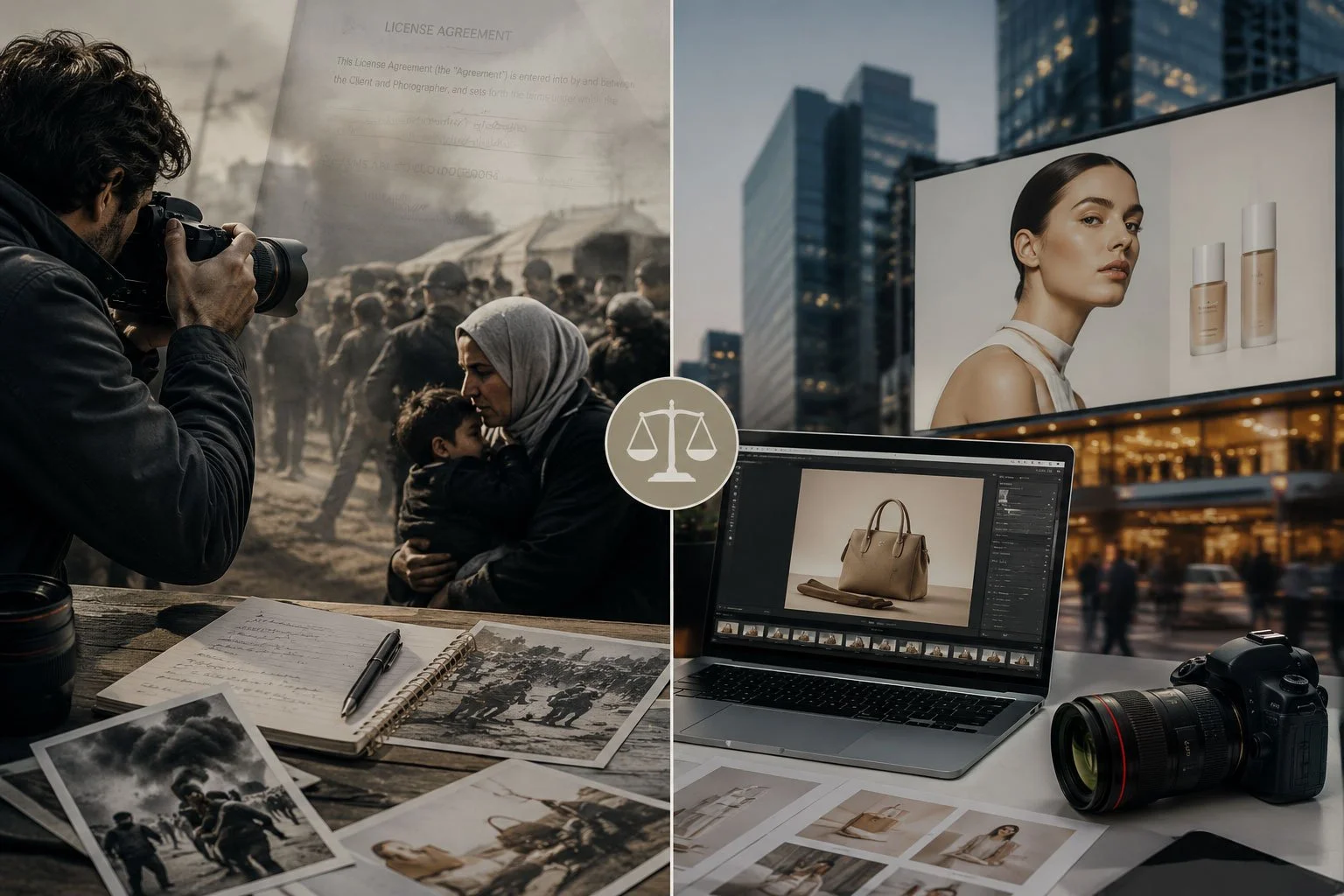
One of the most important distinctions in photography licensing is whether an image is being used for editorial or commercial purposes.
The same photograph may be suitable for either type of use, but the context and purpose of the publication matter.
Editorial Use
Editorial use generally refers to photographs used to inform, report, educate, document, or illustrate a subject.
Common examples include:
Newspaper and magazine articles
News websites
Music and entertainment coverage
Documentary projects
Educational publications
Historical articles and archives
Reviews and reporting about events
For example, a local publication licenses a photograph of a concert to accompany an article reviewing the performance. The image illustrates the subject being discussed.
That is generally an editorial use.
Editorial licenses commonly restrict the use of an image in advertising, product promotion, or other marketing activities.
However, the distinction is not always determined by the type of organization using the photograph. A commercial publisher can publish editorial content, and an image appearing on a website is not automatically editorial or commercial. The purpose and context of the particular use matter.
Commercial Use
Commercial use generally refers to using a photograph to advertise, market, promote, or sell a product, service, business, or organization.
Common examples include:
Business advertising
Marketing campaigns
Promotional websites
Product packaging
Brochures and sales materials
Paid social media advertising
Email marketing
Billboards and outdoor advertising
For example, a venue licenses a concert photograph for use in a promotional campaign encouraging people to buy tickets to upcoming shows.
That is a commercial use because the photograph helps promote the venue and its business.
Editorial vs. Commercial Comparison
| Editorial Use | Commercial Use |
|---|---|
| News reporting | Advertising |
| Journalism | Marketing |
| Educational publications | Product promotion |
| Documentary storytelling | Business promotion |
| Reviews and event coverage | Promotional campaigns |
| Historical or informational articles | Sales materials |
Simple rule: If the photograph is being used to promote or advertise a business, product, service, or organization, it generally requires commercial usage permission. If it is being used to report or inform, it may qualify as editorial use. The actual context and applicable rights still need to be considered.
Can the Same Photograph Be Used Editorially and Commercially?
Yes. A photograph can be licensed for different purposes, provided the photographer has the rights to grant those permissions and the intended use is otherwise lawful.
For example, a concert photograph might be licensed:
To a music publication for an editorial review
To a venue for promotional use
To a festival organizer for an advertising campaign
Each use has a different purpose and may require a separate license.
The fact that a photograph was originally created for editorial coverage does not automatically prevent it from being licensed commercially. However, commercial use may raise additional issues involving recognizable people, trademarks, artwork, private property, or other rights.
A photographer should consider those issues before granting commercial permission.
Personal Use Licenses
Personal use generally refers to private, non-business use of a photograph.
Examples might include:
Displaying a purchased print at home
Using an image as personal desktop or phone wallpaper
Including a photograph in a private family album
Giving a properly purchased print as a gift
Personal use does not mean an image is free to copy or distribute. Copyright still applies, and the person using the photograph must have permission or another legal basis for the use.
A personal print purchase, for example, generally does not grant permission to use the same photograph in business advertising, merchandise, or promotional materials.
The rights granted depend on the purchase terms or license agreement.
Exclusive vs. Non-Exclusive Licensing
Another important licensing decision is whether the rights are exclusive or non-exclusive.
Exclusive License
An exclusive license grants one client exclusive permission within the scope defined by the agreement.
Depending on the terms, the photographer may be restricted from licensing the same image to other clients for the same purpose, territory, or period.
Exclusive licensing often costs more because it limits the photographer's ability to grant similar rights to others.
The agreement should clearly explain what is exclusive. Exclusivity might apply to a particular industry, geographic area, media type, or period rather than every possible use of the photograph.
Non-Exclusive License
A non-exclusive license allows the photographer to grant similar permissions to multiple clients.
The photographer retains copyright and can generally continue licensing the image, subject to any other restrictions or agreements.
Stock photography commonly uses non-exclusive licensing.
Exclusive vs. Non-Exclusive Comparison
| Exclusive License | Non-Exclusive License |
|---|---|
| One client receives defined exclusive rights | Multiple clients may receive similar rights |
| Often carries a higher fee | Often more affordable |
| May limit future licensing | Allows continued licensing |
| Scope and exclusivity period should be defined | Photographer retains greater licensing flexibility |
Duration: How Long Can an Image Be Used?
A photography license should specify how long the client is permitted to use the image.
Common licensing periods include:
One-time use
30 days
Six months
One year
Three years
Five years
Perpetual use
A one-year license, for example, might allow a business to use an image on its website and social media for 12 months.
A perpetual license allows use without a specified expiration date, subject to the other terms of the agreement.
Longer usage periods generally increase the value of a license because the client receives permission for a longer period. However, pricing depends on the complete scope of use, not duration alone.
It is also important to distinguish between the expiration of a license and the removal of an image from materials already distributed. Agreements should address whether existing printed materials can continue to circulate after the license expires.
Territory: Where Can the Image Be Used?
Territory defines the geographic area covered by a license.
Common examples include:
Local
Statewide
Regional
National
North America
Worldwide
A local business may only need permission for use within its immediate market. A national brand may need broader rights for a campaign distributed across the United States.
The geographic reach of a license can affect its value, particularly when an image is used in advertising or large-scale marketing.
For digital content, the agreement should clarify whether the license is limited by the intended audience or campaign territory, since websites and social media posts can often be viewed from anywhere.
Media: Where Can the Photograph Appear?
Media describes the platforms and formats in which the photograph may be used.
Digital Media
Websites
Social media
Email marketing
Mobile applications
Digital advertisements
Online publications
Print Media
Magazines
Newspapers
Books
Brochures
Catalogs
Posters
Product packaging
Outdoor and Display Media
Billboards
Transit advertising
Event signage
Trade show displays
Promotional banners
A license might cover website use but exclude printed advertisements or product packaging.
Adding another platform or format may require expanding the original license.
Print vs. Web Licensing
A website license does not automatically include every type of printed use.
For example, permission to display an image on a business website may not cover:
Printed brochures
Product catalogs
Magazine advertisements
Product packaging
Large-format displays
Likewise, a license for a printed publication does not necessarily authorize use in digital advertising or on social media.
A well-written agreement identifies the media included in the license so both parties understand the permitted uses.
How Photography Licensing Is Priced
Photography does not have one universal licensing price.
The same photograph can have different licensing values depending on how a client intends to use it.
A small business using an image on its website may need a relatively limited license. A national company using that same photograph in a large advertising campaign may require much broader rights.
The image itself has not changed. The scope and value of the permission have.
Professional photographers commonly consider the following factors when pricing image licenses:
Intended use
Commercial or editorial purpose
Audience and exposure
Duration
Geographic territory
Media and platforms
Exclusivity
Number of images
Whether the client can share or sublicense the images
What Determines the Cost of an Image License?
Commercial Purpose
Advertising and marketing uses often carry higher licensing fees than limited editorial uses because the image directly supports a business or promotional objective.
Examples include:
Advertising campaigns
Business websites
Product packaging
Promotional materials
Paid social media campaigns
Audience and Exposure
A photograph used by a small local organization has a different reach from one used in a national advertising campaign.
The size of the intended audience and the prominence of the image can influence the license fee.
Duration
A license for a short campaign may be less expensive than one allowing several years of use.
Longer terms provide the client with more extended permission and may increase the licensing value.
Geographic Territory
A local license and a worldwide advertising license grant very different levels of reach.
Broader geographic rights can increase the value of a license.
Media and Platforms
A license covering a single website may be narrower than one covering websites, social media, print advertising, product packaging, and billboards.
Additional media can expand the value of the permission.
Exclusivity
An exclusive license may prevent the photographer from granting similar rights to other clients.
Because exclusivity can limit future licensing opportunities, it often commands a higher fee.
Number of Images
Licensing one photograph is different from licensing an entire collection for a campaign. The number of images, how they will be used, and whether they are being licensed together can all affect pricing.
Why Usage Matters More Than the Photograph Alone
Imagine photographing a coastal landscape.
One client wants to purchase a print for a living room. Another wants to use the same image in a national tourism campaign.
The photograph is identical, but the commercial value and scope of the requested rights are very different.
Photography licensing is not simply a calculation of how long it took to create an image or how much equipment was used.
It considers the permission being granted and the value that permission provides to the client.
You aren't just selling pixels. You're granting permission. The broader and more valuable the permitted use, the more valuable the license may be.
Common Photography Pricing Mistakes
Photographers who are new to licensing sometimes base every fee on:
Time spent shooting
Number of edited images
Equipment costs
Time spent editing
Those factors can matter when pricing photography services, but image licensing involves a separate consideration: the rights the client receives.
A photograph created in a short amount of time can still have substantial licensing value if it is used in a major advertising campaign.
Likewise, a technically demanding photograph does not automatically justify an unlimited license.
The scope of usage should be evaluated separately from the cost of creating the image.
Real-World Photography Licensing Examples
The following examples illustrate how the same photograph might be licensed for different purposes.
Example 1: Editorial Music Coverage
A newspaper licenses a concert photograph to accompany an article covering a local music festival.
Typical license: Editorial use.
The image illustrates the event being reported on.
Example 2: Business Website
A brewery licenses a landscape photograph for its business website and promotional materials.
Typical license: Commercial use.
The image supports the business's marketing and brand identity.
Example 3: Personal Wall Art
A homeowner purchases a fine art print for display in a living room.
Typical permission: Personal display under the applicable print purchase terms.
Buying the print does not automatically grant copyright ownership or commercial usage rights.
Example 4: Tourism Campaign
A tourism organization licenses a coastal photograph for an annual advertising campaign and requests exclusive use within a defined territory.
Typical license: Exclusive commercial use.
The agreement should specify the campaign period, territory, media, and scope of exclusivity.
Example 5: Stock Photography
A photographer licenses an image through a stock agency to multiple customers over several years.
Typical license: Non-exclusive licensing.
Each customer receives permission under the stock agency's applicable license terms.
One Photograph, Different Licensing Needs
| Client | Intended Use | Licensing Consideration |
|---|---|---|
| Homeowner | Personal wall art | Personal display rights |
| Local business | Website banner | Commercial web use |
| Tourism organization | Promotional brochure | Commercial print use |
| Magazine | Editorial feature | Editorial publication use |
| National retailer | Advertising campaign | Broad commercial use |
| Brand seeking exclusivity | Worldwide marketing | Exclusive commercial use |
The photograph may remain exactly the same. What changes is the scope of the permission being requested.
Common Photography Licensing Mistakes
Many image licensing problems begin with misunderstandings rather than intentional infringement. Businesses, creators, and photographers can all make mistakes when they assume that certain uses are automatically permitted.
Mistakes Businesses Make
Assuming Images Found Online Are Free to Use
Google Images and social media platforms display photographs, but their availability does not grant permission to copy or use them.
Most photographs remain protected by copyright even when they are publicly accessible.
For more information, read Can You Use Images From Google? Copyright Rules Explained.
Using Editorial-Only Images in Advertising
A photograph licensed for editorial use generally cannot be repurposed for advertising or product promotion without appropriate additional permission.
Businesses should check the license restrictions before using an image in a marketing campaign.
Assuming Website Permission Covers Every Use
A license for a website does not necessarily include paid advertising, printed materials, merchandise, or use by third-party partners.
The original agreement determines what is permitted.
Continuing to Use an Image Beyond the License Terms
If a license has an expiration date, the client should review the agreement before continuing to use the image after that period.
A new agreement or renewal may be necessary.
Mistakes Photographers Make
Granting Unlimited Usage Without Considering the Scope
A statement such as "You can use it however you want" may grant much broader permission than intended.
Photographers should define the permitted use, duration, media, territory, and any restrictions on redistribution or sublicensing.
Failing to Track Licensed Images
Without keeping records, photographers can lose track of:
Which clients licensed each image
Where the image may be used
When licenses expire
Whether exclusivity was granted
Whether additional usage has been authorized
Maintaining licensing records helps prevent misunderstandings and makes future renewals easier.
Confusing Image Delivery With Copyright Ownership
Delivering high-resolution files does not automatically transfer copyright.
Photographers should clearly explain what the client is receiving and document the agreed usage rights.
Mistakes Influencers and Content Creators Make
Assuming a Brand Tag or Credit Grants Permission
Tagging a photographer or crediting the source does not automatically authorize use of an image.
Attribution may be required by a license, but it is not a substitute for permission.
Confusing Organic Posts With Paid Advertising
A brand might receive permission to share a photograph in an ordinary social media post but not to use it in paid advertisements or a sponsored campaign.
Those uses can have different commercial value and may require separate licensing.
Assuming Reposting Is Always Permitted
Publicly sharing or reposting an image does not automatically grant permission to reproduce it.
Even when the photographer is credited, the intended use and applicable platform rules still matter.
Social Media and Image Licensing
Social media can make photographs seem freely available because users can view, share, and repost content.
However, public visibility does not place an image in the public domain.
Social platforms generally receive certain permissions from users under their terms of service. Those platform agreements do not ordinarily give unrelated businesses unrestricted rights to download and reuse other users' photographs.
A business should obtain appropriate permission before using someone else's image in its own promotional content.
AI and Image Licensing Considerations
AI-generated imagery has added new questions to copyright and licensing discussions.
The legal status of AI-generated content can depend on how it was created, the human contribution involved, applicable law, and the terms of the service used.
Businesses should not assume that every AI-generated image is automatically free of restrictions or suitable for every commercial project.
When using AI-generated imagery, review the platform's terms and consider any relevant rights involving recognizable people, trademarks, copyrighted material, and other protected content.
For photographers and businesses, clear documentation of image sources and usage permissions remains important.
How Photographers Protect Their Licensing Rights
Professional photographers use written licensing agreements to clarify what clients can and cannot do with their images.
A well-structured agreement should address:
Who: The person or organization receiving permission.
What: The specific photographs covered by the license.
Purpose: Editorial, commercial, personal, or another defined use.
Media: The platforms and formats where the images may appear.
Duration: How long permission lasts.
Territory: The geographic area covered.
Exclusivity: Whether similar rights can be granted to other clients.
Restrictions: Whether modification, redistribution, sublicensing, or other uses are permitted.
Payment: The licensing fee and payment terms.
The agreement should also explain what happens if the client wants to expand the original use.
For example, a business that initially licenses a photograph for its website may later want to use it in a paid advertising campaign. If that use falls outside the original agreement, the business should obtain the necessary additional permission.
Clear terms protect photographers while giving clients a better understanding of the rights they have purchased.
A Simple Checklist Before Using a Photograph
Before using an image, ask the following questions:
Who owns the copyright? Identify the photographer, copyright owner, or authorized licensing provider.
Do I have permission? Confirm that a license, written authorization, or another valid legal basis covers the use.
What is the intended purpose? Determine whether the use is editorial, commercial, personal, or another category.
Where will the image appear? Check whether the license covers the website, social media, print, advertising, or other intended media.
How long can I use it? Review any expiration date or duration restrictions.
Can I modify or share it? Check the terms for cropping, editing, redistribution, and sublicensing.
Are there additional rights to consider? Commercial uses may require consideration of model releases, property releases, trademarks, artwork, or other third-party rights.
If the intended use is not covered by the existing permission, contact the copyright owner or authorized licensing provider before using the photograph.
Rule of thumb: If you did not create the photograph, do not assume you can use it simply because it is available online. Confirm that you have permission or another valid legal basis for the specific use.
Key Takeaways
Photography licensing is about the rights granted to use an image, not simply the image file itself.
The same photograph can have very different licensing values depending on:
Commercial or editorial purpose
Audience and exposure
Duration of use
Geographic territory
Media and platforms
Exclusivity
The number of images being licensed
For photographers, clearly defined licensing terms help protect the value of their work. For businesses and other image users, understanding those terms helps prevent unauthorized use and unexpected licensing disputes.
Frequently Asked Questions
Can I use an image if I credit the photographer?
Not automatically. Crediting the photographer does not replace a license or permission. Attribution may be required under certain licensing agreements, but it does not independently authorize someone to use a copyrighted photograph.
If an image appears on Google, is it free to use?
No. Google indexes images from websites and other sources. It does not grant permission to use them. You must check the copyright status and obtain the necessary permission or license for your intended use.
Do I own photographs I paid a photographer to create?
Not automatically. In most situations, paying for photography services or receiving image files does not transfer copyright ownership. The agreement determines the usage rights granted. Copyright ownership transfers and qualifying work made for hire arrangements are separate legal matters.
Can I use Instagram photos for my business?
Not without an appropriate legal basis. A photograph being publicly available on Instagram does not give businesses permission to download and use it in their own marketing or advertising. Obtain permission from the copyright owner or an authorized licensing provider.
What happens if I use a photograph without permission?
Unauthorized use can lead to a request to remove the image, a demand for licensing compensation, or a copyright infringement claim. Depending on the circumstances, copyright owners may also have legal remedies available under applicable law.
How much does photography licensing cost?
There is no universal price. Licensing fees depend on the intended use, duration, territory, audience, media, exclusivity, and number of images. A limited editorial license or personal print purchase will generally have a different value from a broad commercial advertising license.
Can a business use my photograph after buying a print?
Generally, no. Purchasing a physical print does not automatically grant commercial usage rights or copyright ownership. A separate license is typically needed if the business wants to use the photograph in advertising, marketing, on its website, or in other promotional materials.
What should a photography licensing agreement include?
A licensing agreement should identify the images being licensed, the permitted purpose, media, duration, territory, exclusivity, restrictions, and payment terms. It should also clarify whether the client can modify, redistribute, or sublicense the photographs.
Can an editorial photograph be used in advertising?
Not automatically. An editorial license generally restricts advertising and promotional use. The copyright owner may be able to grant a separate commercial license, but additional considerations such as model releases, property rights, and trademarks may apply.
Does a photography license expire?
It depends on the agreement. Some licenses cover a single use or a limited period, while others grant perpetual permission. Review the terms to determine whether continued use is allowed after the license period ends.
==========
Need licensed photography for your project?
If you’re a business, brand, or organization looking for licensed photography or editorial coverage, usage-based licensing ensures you only pay for what you need.
This includes:
Commercial campaigns
Editorial publications
Event coverage
Brand storytelling
Location and tourism imagery
👉 Learn more about licensing and usage options from Chris Sidoruk Media.
==========
Continue Building Your Copyright Knowledge:
What Is Copyright for Photographers – Learn how copyright automatically protects your images.
Why Photographers Should Register Copyright – Understand the strategic benefits of registration.
Can You Use Images From Google? – Avoid common copyright mistakes when using online images.