

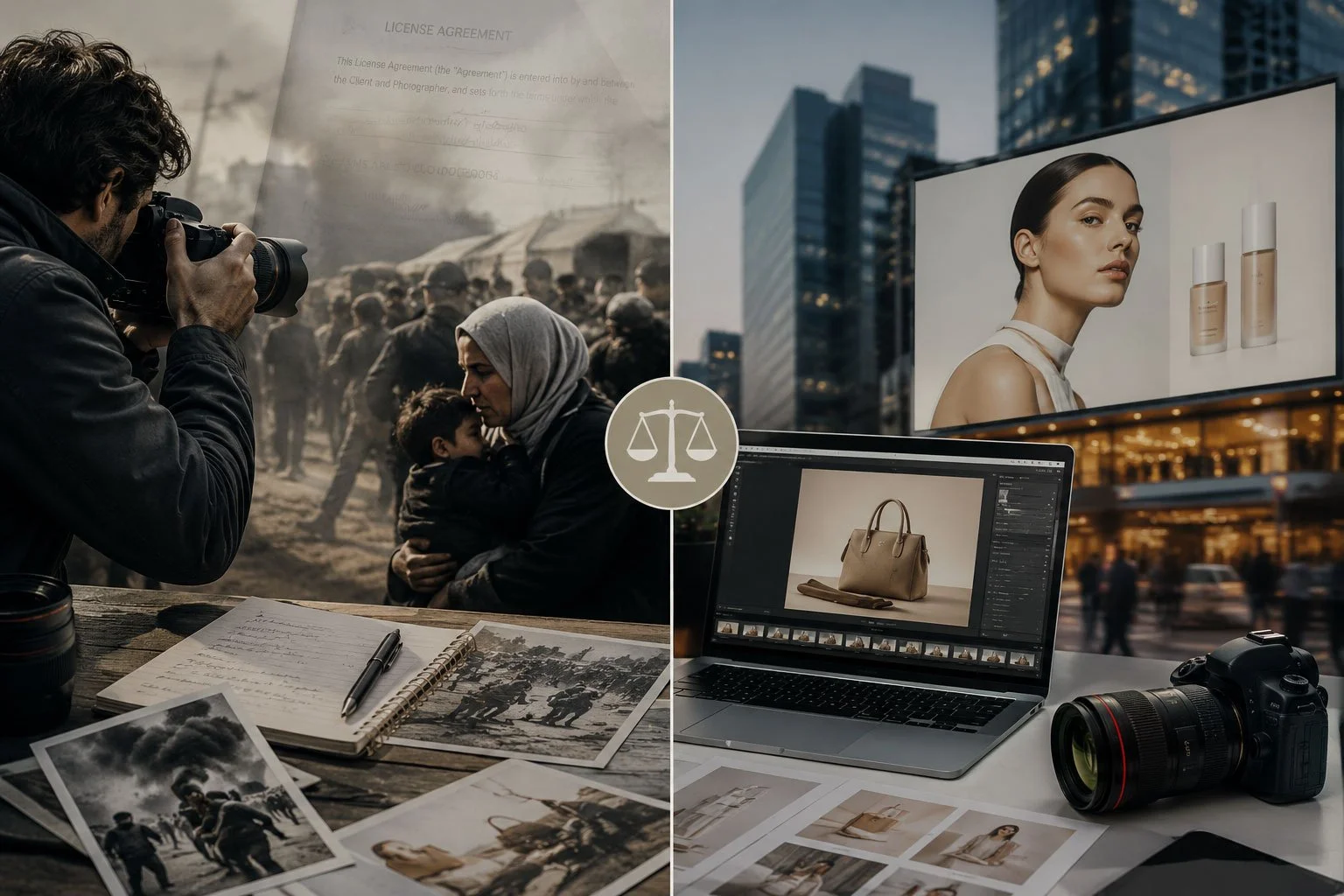
Photography Licensing Guide: Editorial vs Commercial Usage Rights Explained
Last Updated: June 2026
Disclaimer: This article is intended for educational purposes only and should not be considered legal advice. If you need legal advice regarding a specific copyright matter, consult a qualified attorney.
==========
Introduction
Whether you're a photographer licensing your work or a business looking to use an image, understanding photography licensing is essential.
One of the biggest misconceptions in photography is that purchasing a photograph automatically means purchasing the copyright. In reality, that's almost never how professional photography works.
Instead, photographers typically license specific usage rights while retaining ownership of the copyright. Those licenses define exactly who can use an image, where it can be used, how long it can be used, and for what purpose.
Understanding the difference between copyright ownership and image licensing helps photographers protect their work while giving businesses the legal permission they need to use images with confidence.
This guide explains the fundamentals of photography licensing, the different types of usage rights, and the factors that determine how professional image licenses are structured.
New to copyright? Before learning about licensing, it's helpful to understand how copyright ownership works. Read What Is Copyright for Photographers? to learn who owns a photograph, what rights copyright provides, and why licensing is different.
Quick Answer
Photography licensing is legal permission granted by the copyright owner allowing someone else to use a photograph under specific conditions. A license does not transfer copyright ownership; it simply defines how the image may be used.
Key Takeaways
Every original photograph is automatically protected by copyright.
Most photographers license usage rights instead of selling copyright ownership.
A photography license defines how, where, and for how long an image may be used.
Editorial, commercial, and personal licenses all grant different rights.
The value of a license is determined by the scope of the permitted use; not simply the photograph itself.
A photography license is a legal agreement that gives another person or organization permission to use a photograph under specific terms.
Think of it as renting permission, not transferring ownership.
The photographer continues to own the copyright while granting limited rights to someone else.
Those rights might include permission to use an image:
on a business website
in a magazine article
on social media
in advertising
inside printed marketing materials
for personal display
Every license defines exactly what is—and is not—allowed.
Without a license (or another legal exception), someone generally cannot use a copyrighted photograph simply because they found it online.
Think of It Like Renting a House
A useful way to understand licensing is to compare it to renting a home.
When you rent a house:
You can live in it.
You can enjoy it.
You can invite guests over.
But you don't own the property.
You can't sell it, demolish it, or rent it to someone else unless your agreement allows it.
Photography licenses work much the same way.
A business may receive permission to use an image on its website, but that doesn't mean it owns the photograph or can use it for every future project.
The photographer remains the copyright owner unless ownership is specifically transferred in writing.
Copyright vs. Licensing
These two terms are often confused, but they represent very different legal concepts.
Copyright
-Ownership of the photograph.
-Automatically belongs to the creator in most situations.
-Can be sold or transferred.
-Usually lasts for decades under copyright law.
License
-Permission to use the photograph.
-Granted by the copyright owner.
-Can be limited, expanded, or revoked according to the agreement.
-Only lasts for the period defined by the license.
Simple rule:
Copyright answers "Who owns the image?" Licensing answers "Who may use the image?"
If you're unfamiliar with how copyright ownership works, read What Is Copyright in Photography? before continuing. That article explains why photographers automatically own copyright the moment an original image is created.
Why Businesses Often Misunderstand Licensing
Photography licensing is different from purchasing most physical products.
When a business buys a computer, a chair, or a camera, ownership transfers to the buyer.
Photography doesn't work that way.
Hiring a photographer or paying an invoice usually purchases permission to use photographs, not the copyright itself.
That distinction often surprises people because the finished images feel like a completed product. In reality, they're intellectual property protected by copyright law.
This misunderstanding can lead to common questions like:
"We paid for the photos. Don't we own them?"
"Can we use them on our new website?"
"Can we give them to another company?"
"Can we use them in future advertising?"
The answer depends entirely on what the license allows.
Professional licensing agreements remove this uncertainty by clearly defining each party's rights before the images are used.
Common Myths About Photography Licensing
Myth #1: "If I paid for the photos, I own the copyright."
Reality: In most situations, payment purchases a license to use the images—not ownership of the copyright.
Myth #2: "Images on the internet are free to use."
Reality: Most online images remain protected by copyright, regardless of where they're found.
For a deeper explanation, see Can You Use Images From Google? Copyright Rules Explained.
Myth #3: "Giving credit means I don't need permission."
Reality: Attribution does not replace a license.
Crediting the photographer may be required by some licenses, but it does not automatically grant permission to use the work.
Myth #4: "Editing a photo creates a new copyright."
Reality: Cropping, filtering, or adding text generally does not eliminate the original photographer's copyright.
Why Licensing Exists
Licensing isn't designed to make photography more complicated.
It's designed to make expectations clear.
For photographers, licensing protects the long-term value of their work.
For businesses, licensing provides legal certainty about how images can be used.
Rather than negotiating ownership every time a photograph changes hands, licensing creates a flexible system that allows the same image to be used in different ways by different clients under different terms.
That's why licensing has become the standard throughout commercial photography, advertising, publishing, journalism, and creative industries around the world.
Coming Up Next
Now that you understand the difference between copyright ownership and image licensing, the next section explains the different types of photography licenses and when each is used.
You'll learn the differences between:
Editorial licenses
Commercial licenses
Personal use licenses
Exclusive vs. non-exclusive rights
Time, territory, and media restrictions
These concepts form the foundation of nearly every professional photography licensing agreement.
Not every photography license grants the same rights.
A single photograph can be licensed dozens of different ways depending on how it will be used, who will use it, where it will appear, and how long the permission lasts.
That's why professional photographers rarely charge one flat price for every client. Instead, the license is tailored to the intended use.
The sections below explain the most common licensing terms you'll encounter.
Editorial vs. Commercial Photography Licensing
One of the most important distinctions in photography licensing is whether an image is being used editorially or commercially.
Although the same photograph may be eligible for either type of license, the intended use changes the rights required.
Editorial Use
Editorial licensing allows photographs to be used for informational, educational, or journalistic purposes.
Typical examples include:
Newspapers
Magazines
News websites
Documentary projects
Educational publications
Historical archives
Blog articles discussing current events
Editorial images generally cannot be used to advertise or promote a product, service, or business.
Example:
A local newspaper publishes your concert photograph while covering a music festival.
This is typically editorial use.
Commercial Use
Commercial licensing allows photographs to be used to promote, advertise, market, or sell something.
Commercial uses often include:
Business websites
Advertising campaigns
Social media marketing
Product packaging
Brochures
Billboards
Email marketing
Paid digital advertising
Example:
The same concert photograph appears on the venue's homepage encouraging people to purchase tickets.
That is commercial use because the image helps market the business.
Editorial vs. Commercial Comparison
| Editorial | Commercial |
|---|---|
| News reporting | Advertising |
| Journalism | Marketing |
| Educational publications | Business websites |
| Documentary work | Product promotion |
| Informational purpose | Revenue-generating purpose |
Typical Uses:
- News reporting
- Journalism
- Educational publications
- Documentary work
- Informational purpose
Typical Uses:
- Advertising
- Marketing
- Business websites
- Product promotion
- Revenue-generating purpose
Simple rule: If the image helps sell, promote, advertise, or market something, it is generally commercial use.
Personal Use Licenses
Personal use licenses are the most limited type of photography license.
They allow someone to enjoy an image privately without using it for business or commercial purposes.
Examples include:
Printing artwork for a home
Personal desktop or phone wallpapers
Family photo albums
Personal scrapbooks
Gifts for friends or family
A personal license generally does not allow someone to:
sell products
advertise a business
publish marketing materials
create merchandise
redistribute the image
Although personal licenses are common for fine art and portrait photography, they are rarely sufficient for businesses or organizations.
Exclusive vs. Non-Exclusive Licensing
Another major licensing decision is whether the rights are exclusive or non-exclusive.
Exclusive License
An exclusive license gives one client the exclusive right to use a photograph for the agreed purpose.
Depending on the agreement, the photographer may no longer be able to license that image to other clients during the exclusivity period.
Exclusive licenses typically command higher licensing fees because they reduce the photographer's future earning potential.
Non-Exclusive License
A non-exclusive license allows multiple clients to license the same photograph.
The photographer continues to own the copyright and may license the image again in the future.
Most stock photography operates under non-exclusive licensing.
Exclusive vs. Non-Exclusive Comparison
Duration (How Long Can the Image Be Used?)
Every license should define how long permission lasts.
Some licenses allow use for a few months.
Others may continue for years—or even indefinitely.
Common durations include:
One-time use
Six months
One year
Three years
Five years
Perpetual (no expiration)
Longer licenses generally carry greater value because the client receives extended usage rights.
Territory (Where Can the Image Be Used?)
A license should also define where the image may be used geographically.
Examples include:
Local
Statewide
National
North America
Worldwide
A neighborhood restaurant usually needs different licensing rights than an international brand.
The broader the audience, the greater the commercial value of the license.
Media (Where Will the Photograph Appear?)
Media refers to the platforms where the photograph may be displayed.
Examples include:
Digital Media
Websites
Social media
Email marketing
Mobile apps
Digital advertisements
Print Media
Magazines
Newspapers
Books
Brochures
Catalogs
Posters
Packaging
Outdoor Media
Billboards
Transit advertising
Event signage
Trade show displays
Many professional licenses specify exactly which media are included.
Adding additional media often requires expanding the license.
Print vs. Web Licensing
Many people assume that a website license automatically covers printed materials.
It usually doesn't.
A license allowing website use may not permit:
brochures
catalogs
product packaging
magazine advertisements
large-format displays
Likewise, a print license doesn't automatically authorize digital advertising or social media campaigns.
Professional licensing agreements often separate these rights because each type of media creates different commercial value.
Real-World Licensing Examples
Understanding licensing becomes much easier when viewed through practical examples.
Example 1
A newspaper licenses your photograph to accompany an article covering a local music festival.
License Type
✔ Editorial
Example 2
A brewery licenses one of your landscape photographs for a statewide advertising campaign.
License Type
✔ Commercial
Example 3
A couple purchases one of your fine art prints for display in their living room.
License Type
✔ Personal Use
Example 4
A tourism board licenses one of your coastal photographs exclusively for its annual marketing campaign.
License Type
✔ Exclusive Commercial License
Example 5
A stock photography agency licenses your image to multiple companies over several years.
License Type
✔ Non-Exclusive Commercial License
Quick Licensing Comparison
Key Takeaway
Every photography license answers the same fundamental questions:
Who may use the image?
Where may it appear?
How may it be used?
For how long may it be used?
In which media may it appear?
Is anyone else allowed to license the image?
Understanding these variables is the foundation of professional image licensing and explains why two licenses for the same photograph can have very different values.
Continue learning:
What Is Copyright? — explains who owns a photograph from the moment it is created.
Copyright Registration Benefits for Photographers — explores when registration strengthens your legal position.
Can You Use Images From Google? — explains why finding an image online does not grant permission to use it.
One of the biggest misconceptions about photography licensing is that a photograph has a fixed price.
It doesn't.
A photograph has different values depending on how the buyer intends to use it.
The same image might be worth:
$100 for a personal print
$500 for a local business website
$2,000 for a regional advertising campaign
$20,000+ for a nationwide commercial campaign
The photograph hasn't changed.
Only the license has.
That's why professional photographers price licensing based on usage rights, not simply on the image itself.
How do photographers price image licensing?
Professional photographers typically price image licenses based on how the image will be used—not just the photograph itself. Factors such as commercial use, audience size, duration, exclusivity, geographic territory, and media type all influence the licensing fee.
What Determines the Cost of an Image License?
Several factors determine the value of a license.
Together, these factors define how much value the client receives from using the image.
Commercial Purpose
Commercial advertising almost always commands a higher licensing fee than editorial or personal use because the image directly supports revenue generation.
Examples include:
Advertising campaigns
Company websites
Product packaging
Marketing materials
Paid social media advertising
Audience Size
The more people who see an image, the greater its commercial value.
A photograph used by a local nonprofit has a very different value than one appearing in a nationwide advertising campaign.
Typical examples include:
Local business
Regional company
National brand
International campaign
Duration
How long will the client use the image?
Common licensing periods include:
30 days
6 months
1 year
3 years
Perpetual
Generally, longer licenses carry higher fees because the client receives greater long-term value.
Territory
Licensing often specifies where an image may be used.
Common territories include:
Local
Statewide
National
Worldwide
A worldwide campaign generally commands a higher licensing fee than local use.
Media
The same photograph may have completely different values depending on where it appears.
Examples include:
Website
Social media
Printed brochures
Magazines
Billboards
Television
Digital advertising
Every additional medium expands the value of the license.
Imagine photographing a mountain landscape.
One client wants to print it for their living room.
Another wants to place the same image on billboards across the country for the next three years.
The file is identical.
The value isn't.
Photography licensing isn't based on how difficult a photograph was to create.
It's based on the business value the image provides to the client.
This concept, often called usage-based licensing, is the foundation of commercial photography pricing.
Think of it this way. You aren't selling pixels. You're selling permission. The broader the permission, the more valuable the license becomes.
Real-World Licensing Examples
These examples illustrate how licensing changes depending on the intended use.
Example: One Photograph, Six Different Licenses
The exact same image could be licensed six completely different ways.
The photograph never changes.
Only the rights being purchased do.
Common Pricing Mistake
Many new photographers charge based only on:
Time spent shooting
Number of edited images
Equipment costs
Professional commercial licensing adds another layer:
The value created for the client.
That is why two identical photographs can command dramatically different licensing fees.
Most licensing problems don’t come from malicious intent.
They come from misunderstanding how usage rights actually work.
Whether you're a business, creator, or influencer, the same patterns show up again and again.
Mistakes Businesses Make With Image Licensing
Businesses are one of the most common sources of unintentional copyright issues.
Assuming “found online = free to use”
Just because an image appears in Google Search does not mean it is licensed for use.
In most cases:
It is copyrighted by default
It requires permission or a license
“Credit” does not replace licensing
Using stock images outside license terms
Common issues include:
Using “editorial-only” images for advertising
Continuing use after license expiration
Using images across more platforms than permitted
Treating website usage as low-risk
Many businesses underestimate website imagery.
But website usage can still be:
Commercial use
Brand representation
Lead generation
Which often places it in a commercial license category, not “personal use.”
Mistakes Creators Make
Photographers and creators also misinterpret licensing—often in ways that reduce long-term income.
Giving away unlimited usage by default
A common mistake:
“You can use it however you want.”
This often unintentionally transfers far more value than intended.
Instead, usage should always be defined:
Where it can be used
How long it can be used
Whether it can be resold or reused
Not tracking where images are licensed
Without tracking:
Licenses get reused without renewal
Images are redistributed unknowingly
Revenue opportunities are lost
Confusing delivery with ownership
Delivering an image to a client does NOT automatically mean:
They own copyright
They can reuse it indefinitely
They can resell it
Ownership and licensing are separate concepts.
Mistakes Influencers Make
Influencers often operate in a hybrid space between personal content and commercial use.
Using brand images without clarification
A common misunderstanding:
“They sent it to me”
“They tagged me”
“It was on their press kit”
None of these automatically grant commercial usage rights.
Not separating sponsored vs organic usage
An image used in:
Organic post
Sponsored post
Paid ad campaign
may require different licensing terms, even if it’s the same image.
Assuming reposting equals permission
Reposting or resharing does not equal licensing.
Even if:
The original creator is tagged
The brand is mentioned
The post is collaborative
Licensing still applies.
AI and Image Licensing Confusion
AI has introduced one of the most misunderstood areas of modern copyright.
Assuming AI-generated = copyright-free
In many cases:
AI outputs may still be subject to platform terms
Commercial use may be restricted
Training data sources can create legal uncertainty
Using AI images as “safe substitutes”
AI images do not automatically replace licensed photography for:
Advertising campaigns
Editorial publishing
Brand identity use
Risk tolerance varies by industry.
Not understanding training data concerns
Even if usage is technically allowed, businesses should consider:
Brand safety
Licensing clarity
Ethical sourcing concerns
Social Media Licensing Mistakes
Social platforms create confusion because content feels “public.”
But public visibility ≠ usage rights.
Thinking social media = public domain
Posting an image publicly does NOT:
Remove copyright
Grant usage rights
Allow commercial reuse
Ignoring platform-specific licenses
Most platforms (Instagram, Facebook, etc.) operate under:
User-to-platform licensing agreements
Not user-to-user licensing transfers
Reposting without checking commercial intent
A post that feels harmless:
May still be used in ads
May be used in brand campaigns
May be scraped into commercial databases
Can I use an image if I credit the photographer?
No. Credit does not replace a license or permission.
If an image is on Google, is it free to use?
No. Google indexes images—it does not grant usage rights.
Do I own images I paid a photographer for?
Not automatically. You own what the license defines—not the copyright itself.
Can I use Instagram photos in my business?
Not without permission. Posting publicly does not grant commercial rights.
What happens if I use an image without a license?
Potential outcomes include:
Takedown requests
Licensing fee demands
Legal claims in serious cases
Simple Licensing Decision Tree
Use this quick framework before using any image.
Do I want to use this image?

        ↓

Did I create it myself?
→ Yes → You likely own the copyright
→ No  ↓

Did I get explicit permission or a license?
→ Yes → Check usage terms
→ No  ↓

Is it from Google / social media / website?
→ Yes → Assume it is copyrighted
→ No  ↓

Do I need it for commercial use?
→ Yes → You MUST obtain a license
→ No  ↓

Is it personal/private use only?
→ Possibly fair use, but still risky
Rule of thumb
If you did not create it, and you do not have a license for it, you do not have usage rights.
Key Takeaways
Photography licensing is not about the image itself—it is about how the image is used.
The same photograph can have drastically different value depending on:
Audience size
Commercial intent
Duration of use
Geographic reach
Media placement
Understanding usage rights is essential for both photographers and businesses to avoid legal and financial risk.
Need licensed photography for your project?
If you’re a business, brand, or organization looking for licensed photography or editorial coverage, usage-based licensing ensures you only pay for what you need.
This includes:
Commercial campaigns
Editorial publications
Event coverage
Brand storytelling
Location and tourism imagery
👉 Learn more about licensing and usage options from Chris Sidoruk Media.
==========
Continue Building Your Copyright Knowledge:
What Is Copyright for Photographers – Learn how copyright automatically protects your images.
Why Photographers Should Register Copyright – Understand the strategic benefits of registration.
Can You Use Images From Google? – Avoid common copyright mistakes when using online images.
