

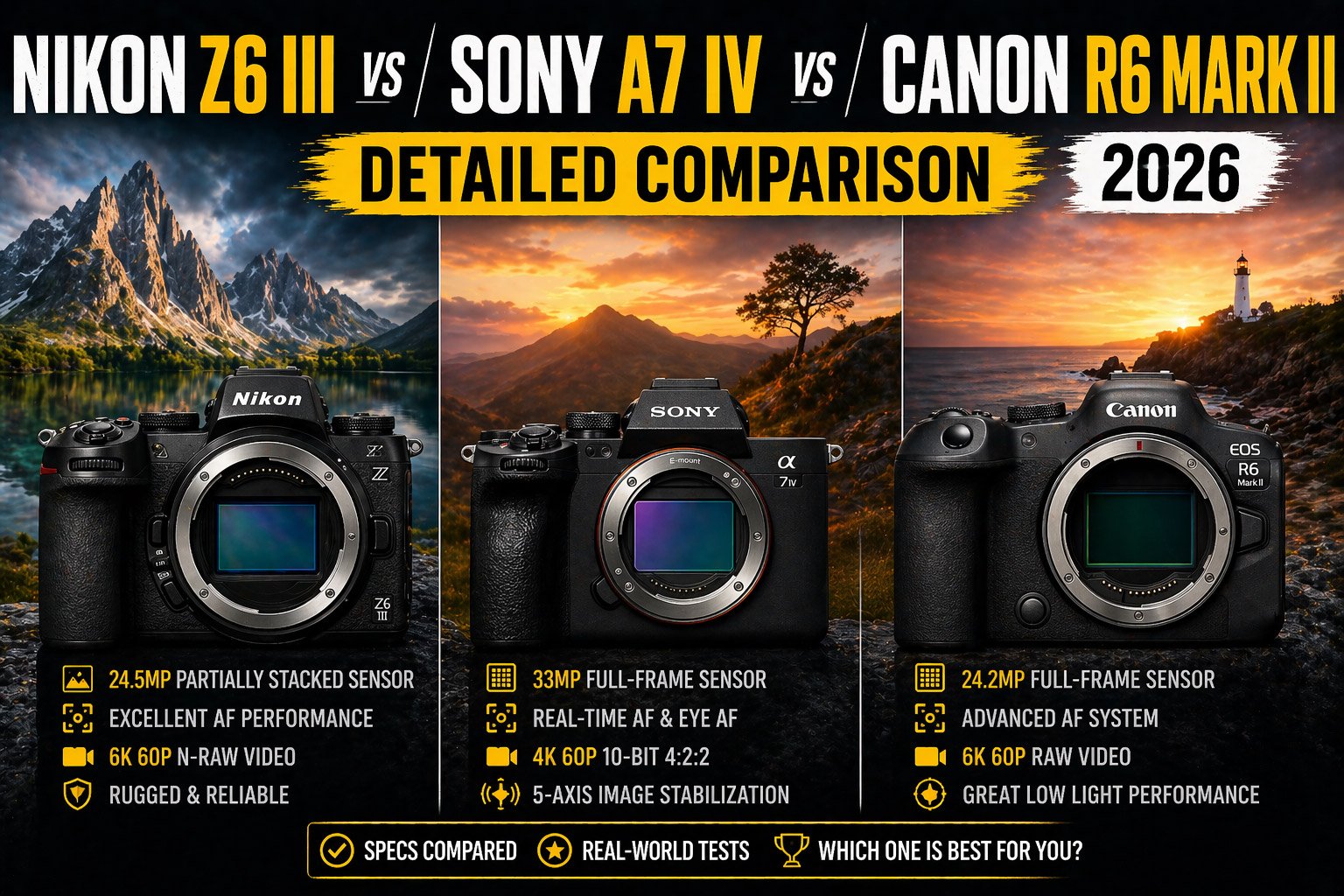
Nikon Z6 III vs Sony A7 IV vs Canon R6 Mark II (Detailed Comparison 2026)
*Some links in this article are affiliate links. If you purchase through them, it helps support my work at no extra cost to you.
==========
Last Updated April 2026
2026 Update: New Hybrid Cameras (What’s Changed)
Since this comparison was originally created, newer hybrid cameras have been released outside of this comparison—including the Canon EOS R6 Mark III.
While the R6 Mark II remains a strong option, the newer model improves:
autofocus performance
low light consistency
hybrid shooting capabilities
👉 If you’re considering upgrading or want the latest model:
Canon EOS R6 Mark III Review
👉Looking for a broader breakdown of the best hybrid cameras available right now?
Best Hybrid Cameras 2026 Guide
For now, this comparison focuses on the R6 Mark II, Sony A7 IV, and Nikon Z6 III as they remain widely used and relevant options.
If you’re choosing between the Nikon Z6 III, Sony A7 IV, and Canon EOS R6 Mark II, you’re comparing three of the most popular hybrid cameras used in real-world shooting.
All three can handle both photo and video at a high level. The real question is:
👉 Which one fits your shooting style best?
This guide breaks them down based on real-world use, especially for concert photography, low light, and hybrid shooting.
Quick Comparison Summary
Best overall balance (of these three): Nikon Z6 III
Best autofocus (of these three): Sony A7 IV
Best hybrid (photo + video, of these three): Canon R6 Mark II
What Matters in a Hybrid Camera
Before comparing specs, here’s what actually matters:
low-light performance
autofocus reliability
video capability
usability and workflow
If you shoot concerts or events, low-light and autofocus matter the most.
👉 For a full breakdown of real-world concert settings:
→ Best Camera Settings for Concert Photography
👉 For handling difficult lighting:
→ Concert Photography Low Light Tips
Nikon Z6 III (Best Overall Balance)

The Nikon Z6 III is one of the most well-rounded hybrid cameras available.
Why It Stands Out
strong low-light performance
fast and responsive shooting
excellent video capabilities (6K options)
balanced workflow
Real-World Use
Performs well in:
concerts
events
hybrid photo/video work
Where It Falls Short
not the highest resolution
not as autofocus-heavy as Sony
Bottom Line
If you want one camera that handles almost everything well, this is one of the safest choices.
👉 Check current pricing on Amazon
Sony A7 IV (Best Autofocus)

The Sony A7 IV stands out for its autofocus system.
Why It Stands Out
industry-leading subject tracking
very reliable focus in difficult lighting
strong all-around performance
Real-World Use
Best for:
fast-moving subjects
unpredictable environments
situations where focus accuracy is critical
Where It Falls Short
menus can feel complex
not as video-focused as some competitors
Bottom Line
If autofocus reliability is your priority, this is one of the strongest options.
👉 Check current pricing on Amazon
Canon EOS R6 Mark II (Best Hybrid Performance)

The Canon R6 Mark II is built for hybrid shooters.
Why It Stands Out
excellent photo + video balance
strong autofocus system
great usability
Real-World Use
Ideal for:
creators shooting both photo and video
fast-paced environments
event coverage
Where It Falls Short
lower resolution
slightly less dynamic range in some situations
Bottom Line
If you want a camera that handles both stills and video equally well, this is a strong choice.
👉 Check current pricing on Amazon
If you're already considering the Canon ecosystem but want the latest performance improvements:
👉 See the Canon EOS R6 Mark III Review
Key Differences (Quick Breakdown)
Low Light:
Z6 III slightly ahead
R6 II very close
A7 IV still strong
Autofocus:
Sony A7 IV leads
Canon close second
Nikon improved but slightly behind
Video:
Z6 III and R6 II strongest
A7 IV still capable
Usability:
Canon easiest
Nikon balanced
Sony most complex
Which Camera Should You Choose?
Choose Nikon Z6 III if:
you want the best overall balance
you shoot concerts or events
you value low-light performance
Choose Sony A7 IV if:
autofocus is your top priority
you shoot fast-moving subjects
you want strong tracking
Choose Canon R6 Mark II if:
you shoot both photo and video equally
you want a user-friendly system
you value hybrid performance
Concert and Festival Use
All three cameras perform well in concerts.
But when you add festivals:
longer days
more movement
more lighting variation
your choice matters more.
👉 If you plan to shoot festivals, see:
→ Music Festival Photography Guide
Camera vs Lens (Don’t Ignore This)
No matter which camera you choose, your lens will have a major impact on your results.
👉 See: Best Lenses for Concert Photography
Final Thoughts
All three of these cameras are capable.
The difference comes down to how you shoot.
Nikon = balance
Sony = autofocus
Canon = hybrid
There is no wrong choice here. Only the one that fits your workflow best.
Frequently Asked Questions
Q: Which is better for low light, Nikon Z6 III or Sony A7 IV?
A: Both perform well, but the Z6 III has a slight edge in low-light usability.
Q: Is the Canon R6 Mark II good for video?
A: Yes, it’s one of the strongest hybrid options for both photo and video.
Q: Which camera is best for concert photography?
A: All three perform well, but the Z6 III offers one of the best overall balances.
Q: Do I need a hybrid camera for concerts?
A: Not necessarily, but hybrid cameras give you flexibility if you also shoot video.
==========
Explore more:
