

Best Cameras for Astrophotography (2026 Buying Guide)
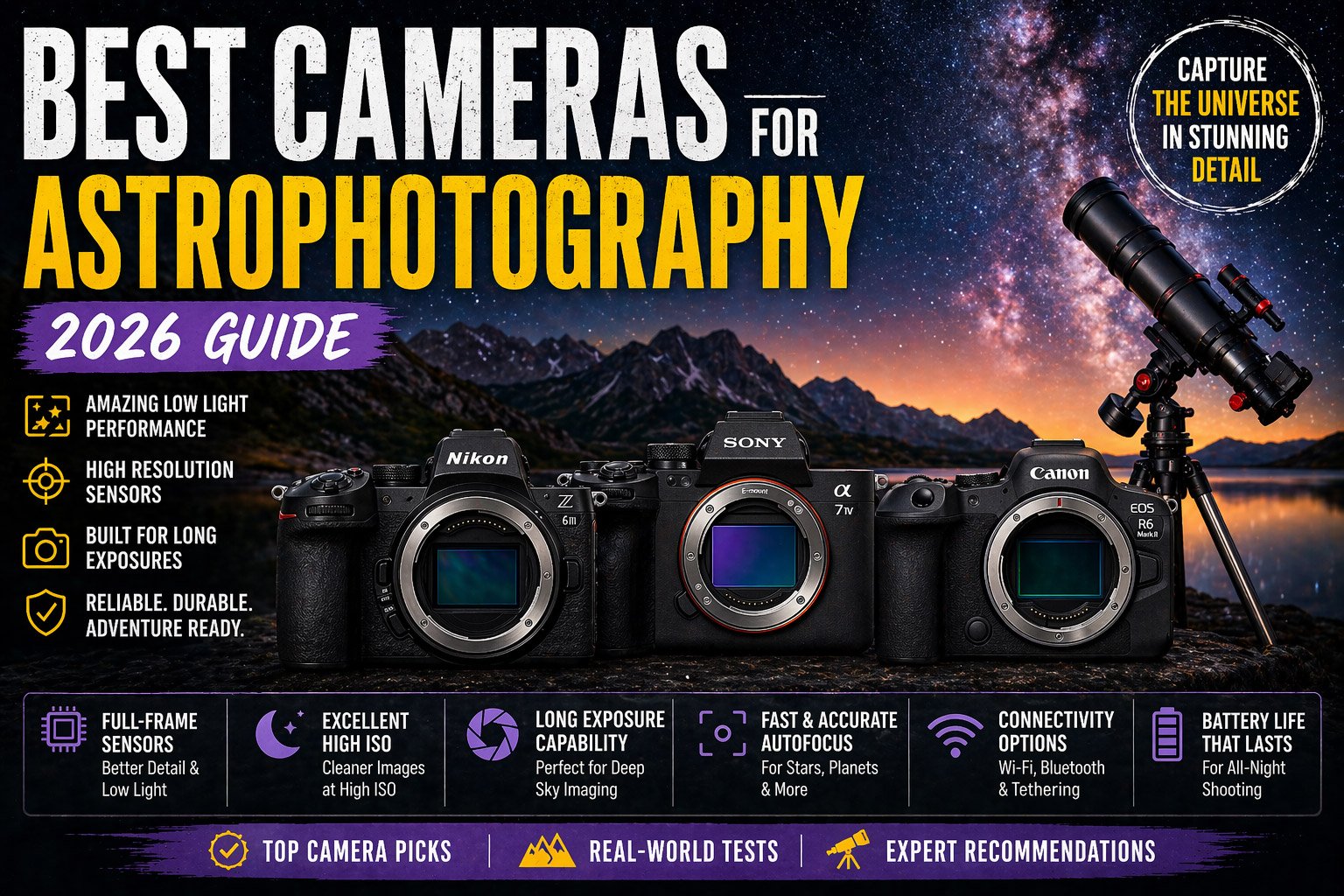
*Some links in this article are affiliate links. If you purchase through them, it helps support my work at no extra cost to you.
==========
Last updated: July 2026
Quick Jump
Photographing the night sky is one of the most rewarding areas of landscape photography, but astrophotography places very different demands on a camera compared to everyday shooting.
A camera that performs beautifully during the day may struggle when pushed to high ISO settings, long exposures, and extremely low-light environments.
The best astrophotography cameras in 2026 are not necessarily the ones with the highest resolution or most advanced autofocus systems. Instead, the strongest options balance:
clean high-ISO image quality
strong dynamic range
manageable file sizes
excellent lens choices
reliable manual controls
features that make shooting at night easier
For most Milky Way photography and night landscapes, a full-frame camera remains the easiest recommendation because the larger sensor generally provides better low-light performance and cleaner files. However, APS-C and Micro Four Thirds cameras can still produce excellent results when paired with fast wide-angle lenses and good technique.
In this guide, I’ll cover the best cameras for astrophotography in 2026, from versatile full-frame options to specialized cameras with unique night photography features.
Whether you’re photographing:
the Milky Way
star trails
moonlit landscapes
meteor showers
night sky panoramas
deep-sky objects
choosing the right camera can make the process easier and help you capture cleaner, more detailed images.
Quick Picks: Best Cameras for Astrophotography
If you want a quick recommendation:
| Category | Camera | Why It Stands Out |
|---|---|---|
| Best Overall Astrophotography Camera | Nikon Z6III | Excellent balance of resolution, low-light performance, and lens options |
| Best Low-Light Specialist | Sony a7S III | Outstanding high-ISO performance and large-pixel full-frame sensor |
| Best Canon Camera for Astrophotography | Canon EOS R6 Mark II | Strong full-frame performance with excellent noise control |
| Best Value Full-Frame Option | Sony a7 III | Proven low-light performance at a more accessible price |
| Best APS-C Camera | Fujifilm X-T5 | Lightweight system with excellent image quality |
| Best Camera With Astro Features | OM System OM-1 Mark II | Starry Sky AF and Live Composite features |
| Best Built-In Star Tracking Option | Pentax K-1 Mark II | Astrotracer simplifies certain star photography workflows |
Best Overall Astrophotography Camera
Camera: Nikon Z6III
Why It Stands Out: Excellent balance of resolution, low-light performance, and lens options
Best Low-Light Specialist
Camera: Sony a7S III
Why It Stands Out: Outstanding high-ISO performance and large-pixel full-frame sensor
Best Canon Camera for Astrophotography
Camera: Canon EOS R6 Mark III
Why It Stands Out: Strong full-frame performance with excellent noise control
Best Value Full-Frame Option
Camera: Sony a7 III
Why It Stands Out: Proven low-light performance at a more accessible price
Best APS-C Camera
Camera: Fujifilm X-T5
Why It Stands Out: Lightweight system with excellent image quality
Best Camera With Astro Features
Camera: OM System OM-1 Mark II
Why It Stands Out: Starry Sky AF and Live Composite features
Best Built-In Star Tracking Option
Camera: Pentax K-1 Mark II
Why It Stands Out: Astrotracer simplifies certain star photography workflows
Astrophotography Camera Comparison (2026)
Before choosing a camera, it helps to understand where each model fits.
| Camera | Sensor | Best For | Key Advantage | Best User |
|---|---|---|---|---|
| Nikon Z6III | Full Frame | Overall astrophotography | Excellent balance of resolution and ISO performance | Most photographers |
| Sony a7S III | Full Frame | Extreme low light | Exceptional high ISO capability | Dedicated night shooters |
| Canon EOS R6 Mark II | Full Frame | Canon users | Strong files and excellent usability | Existing Canon photographers |
| Sony a7 III | Full Frame | Budget astro setup | Proven low-light performance | Beginners upgrading to full frame |
| Fujifilm X-T5 | APS-C | Travel astrophotography | High resolution in a compact system | Hikers and travelers |
| OM System OM-1 Mark II | Micro Four Thirds | Feature-driven shooting | Starry Sky AF and Live Composite | Outdoor photographers |
| Pentax K-1 Mark II | Full Frame DSLR | Star tracking | Built-in Astrotracer | Specialized astro shooters |
Nikon Z6III
Sensor: Full Frame
Best For: Overall astrophotography
Key Advantage: Excellent balance of resolution and ISO performance
Best User: Most photographers
Sony a7S III
Sensor: Full Frame
Best For: Extreme low light
Key Advantage: Exceptional high ISO capability
Best User: Dedicated night shooters
Canon EOS R6 Mark II
Sensor: Full Frame
Best For: Canon users
Key Advantage: Strong files and excellent usability
Best User: Existing Canon photographers
Sony a7 III
Sensor: Full Frame
Best For: Budget astro setup
Key Advantage: Proven low-light performance
Best User: Beginners upgrading to full frame
Fujifilm X-T5
Sensor: APS-C
Best For: Travel astrophotography
Key Advantage: High resolution in a compact system
Best User: Hikers and travelers
OM System OM-1 Mark II
Sensor: Micro Four Thirds
Best For: Feature-driven shooting
Key Advantage: Starry Sky AF and Live Composite
Best User: Outdoor photographers
Pentax K-1 Mark II
Sensor: Full Frame DSLR
Best For: Star tracking
Key Advantage: Built-in Astrotracer
Best User: Specialized astro shooters
What Makes a Good Astrophotography Camera?
A good astrophotography camera is not defined by one specification.
Night sky photography combines extremely low light, long exposures, and demanding editing workflows. The best cameras are the ones that handle these challenges consistently.
Low-Light Performance
This is the most important factor.
Astrophotography often requires ISO settings ranging from approximately ISO 800 to 6400 or higher depending on conditions, lens choice, and whether you are photographing the Milky Way, stars, or darker landscapes.
A strong astrophotography camera should produce:
low image noise at higher ISO settings
good shadow recovery
accurate color reproduction in dark skies
minimal loss of fine detail
A clean 24-megapixel file is often more useful for astro than a much higher-resolution sensor that creates larger files and more visible noise.
Sensor Size
Sensor size plays a major role in night photography.
Full Frame
Full-frame cameras remain the easiest recommendation because they generally provide:
better low-light performance
cleaner high ISO images
wider lens choices
better control over depth of field
For photographers primarily shooting:
Milky Way landscapes
nightscapes
dark-sky locations
full frame is usually the strongest choice.
APS-C
APS-C cameras are still very capable.
The advantages include:
smaller bodies
lighter lenses
lower cost
easier travel setups
Modern APS-C cameras like the Fujifilm X-T5 can produce excellent astrophotography results, especially when paired with a fast wide-angle lens.
Resolution Balance
More megapixels do not automatically mean better astrophotography.
Higher resolution can provide more detail, but it can also introduce:
larger files
more storage requirements
increased processing time
For most landscape astrophotographers, the ideal range is often around:
20–30 megapixels
This provides enough detail while maintaining strong low-light performance.
Lens Selection
The camera body is only part of the equation.
Astrophotography depends heavily on having the right lens.
The most desirable characteristics are:
Wide focal lengths
Common choices:
14mm
16mm
20mm
24mm
These allow you to capture large portions of the sky.
Fast apertures
A lens around:
f/1.4
f/1.8
f/2.8
allows more light to reach the sensor, which helps capture more stars while keeping ISO lower.
A great camera paired with a slow lens will usually perform worse than a more affordable camera paired with a fast, high-quality lens.
Manual Controls and Night Features
Astrophotography requires precise control.
Useful features include:
full manual exposure
RAW capture
long exposure capability
illuminated controls
electronic viewfinder
good battery performance
Some cameras also include specialized night features:
Starry Sky AF
Available on select OM System cameras, this helps simplify focusing on stars.
Live Composite
A feature designed for easier star trails and long exposure effects.
Astrotracer
Pentax cameras use sensor movement combined with GPS information to compensate for Earth’s rotation for certain astrophotography applications.
These features are helpful, but they are not required. A good camera, lens, and tripod remain the foundation of successful astrophotography.
Why Tripods Still Matter
Even the best astrophotography camera requires stability.
Night sky photography typically involves:
long exposures
careful composition
precise focusing
A sturdy tripod is one of the most important accessories you can own.
For recommendations:
Detailed Camera Reviews
1. Nikon Z6III — Best Overall Astrophotography Camera
Best overall balance of image quality, low-light performance, and versatility
For most photographers looking for one camera that can handle astrophotography without significant compromises, the Nikon Z6III is one of the strongest choices in 2026.
Astrophotography requires a balance. You need enough resolution to capture detailed landscapes and stars, but you also need clean files when shooting at high ISO in extremely dark conditions.
The Z6III fits that balance extremely well.
With its 24.5MP full-frame sensor, Nikon Z mount lens compatibility, and strong low-light performance, it provides the combination most nightscape photographers actually need.
👉 Check current price on Amazon
👉 Check current price on Adorama
Why the Nikon Z6III Works So Well for Astrophotography
The Z6III is not designed as a dedicated astro camera, and that is exactly why it works well for many photographers.
It is a highly capable hybrid camera that can handle:
Milky Way landscapes
night photography
daytime landscapes
travel photography
wildlife and outdoor shooting
That versatility matters because many photographers are not buying a camera only for astrophotography.
The Z6III offers:
✔ Excellent high ISO performance
✔ Full-frame sensor advantages
✔ Manageable 24.5MP files
✔ Strong dynamic range
✔ Excellent Nikon Z lens options
✔ Reliable manual controls
Best Lenses for the Nikon Z6III
The camera body is only half the equation.
For astrophotography, pairing the Z6III with a fast wide-angle lens makes the biggest difference.
Strong options include:
A fast prime lens like the 20mm f/1.8 S is especially appealing for Milky Way photography because it allows more light collection while keeping the setup relatively lightweight.
Who Should Buy the Nikon Z6III?
The Z6III is the best choice for:
✔ Photographers who shoot both landscapes and astrophotography
✔ Nikon users upgrading to mirrorless
✔ Travel photographers who need one versatile body
✔ Anyone wanting a long-term full-frame system
It is probably the camera I would recommend to the widest range of astrophotographers.

2. Sony a7S III — Best Low-Light Specialist
Best camera for photographers who prioritize extreme high ISO performance
The Sony a7S III remains one of the most specialized low-light cameras available.
Unlike many modern cameras that prioritize resolution, the a7S III takes a different approach with a 12.1MP full-frame sensor designed around sensitivity and clean files.
That lower resolution is not a weakness for astrophotography.
In fact, it is one of the reasons this camera performs so well at night.
👉 Check current price on Amazon
👉 Check current price on Adorama
Why the Sony a7S III Is Excellent for Astro
The a7S III excels when light is limited.
Its strengths include:
✔ Extremely clean high ISO files
✔ Excellent shadow recovery
✔ Large pixels designed for sensitivity
✔ Outstanding low-light autofocus performance
✔ Strong battery life
For photographers who regularly shoot:
very dark skies
remote locations
night landscapes
star fields
moonless Milky Way scenes
the a7S III remains a compelling option.
The Resolution Tradeoff
The biggest consideration is the 12.1MP sensor.
For:
large landscape prints
aggressive cropping
detailed daytime photography
higher-resolution cameras have an advantage.
However, for many astrophotography situations, 12MP is still enough.
A well-exposed 12MP image of the Milky Way can look incredible, especially when the goal is sharing online or producing moderate-sized prints.
Who Should Buy the Sony a7S III?
The a7S III is ideal for:
✔ Dedicated night photographers
✔ Photographers who prioritize ISO performance above resolution
✔ Hybrid shooters who also create low-light video
✔ Dark-sky travelers
If astrophotography is your primary reason for buying a camera, this is one of the strongest specialist choices.
3. Canon EOS R6 Mark II — Best Canon Camera for Astrophotography
Best option for Canon shooters wanting a modern full-frame mirrorless system
Canon photographers have several excellent options, but the EOS R6 Mark II is one of the most balanced choices for astrophotography.
Its 24.2MP full-frame sensor provides the resolution and low-light performance needed for night landscapes without creating unnecessarily large files.
👉 Check current price on Amazon
👉 Check current price on Adorama
Why the Canon EOS R6 Mark II Works for Astro
The R6 Mark II offers the qualities that matter most:
✔ Strong high ISO performance
✔ Excellent color reproduction
✔ Reliable autofocus system
✔ Comfortable handling
✔ Extensive RF lens ecosystem
For photographers already invested in Canon, it provides a very natural path into astrophotography.
Canon RF Lens Options
The RF mount offers several excellent choices.
Popular astrophotography lenses include:
The affordable RF 16mm f/2.8 is especially interesting for beginners because it provides a lightweight, fast wide-angle option.
Who Should Buy the Canon EOS R6 Mark II?
The R6 Mark II makes the most sense for:
✔ Existing Canon photographers
✔ Landscape photographers wanting one hybrid camera
✔ Travelers who shoot both day and night
✔ Photographers wanting a long-term RF system
It may not beat the a7S III for extreme low-light specialization, but it is a much more versatile all-around camera.
4. Sony a7 III — Best Value Full-Frame Astrophotography Camera
A proven budget-friendly option that still delivers excellent results
Although newer cameras have replaced it in Sony's lineup, the Sony a7 III remains one of the best-value full-frame cameras for astrophotography.
Its 24.2MP full-frame sensor has already proven itself in countless low-light photography situations.
👉 Check current price on Amazon
👉 Check current price on Adorama
Why the Sony a7 III Still Makes Sense
The a7 III offers:
✔ Excellent dynamic range
✔ Strong high ISO performance
✔ Full-frame image quality
✔ Huge selection of Sony E-mount lenses
✔ Lower used-market pricing
For someone entering full-frame astrophotography without spending flagship-camera money, it remains a very smart choice.
Limitations Compared With Newer Cameras
The tradeoffs are mostly related to age:
older autofocus system
lower-resolution rear screen
fewer modern features
older menu system
However, none of those significantly impact basic Milky Way photography.
The final image quality is still excellent.
Who Should Buy the Sony a7 III?
The a7 III is ideal for:
✔ Beginners moving into full frame
✔ Budget-conscious astrophotographers
✔ Landscape photographers
✔ Sony users building a lens collection
If you find a good deal, it remains one of the best entry points into full-frame astrophotography.

5. Fujifilm X-T5 — Best APS-C Astrophotography Camera
Best compact system for photographers who value portability
Full-frame cameras dominate astrophotography recommendations, but APS-C should not be overlooked.
The Fujifilm X-T5 proves that smaller sensors can still produce excellent night sky images.
With its 40.2MP APS-C sensor, strong image quality, and compact design, it is one of the best options for photographers who prioritize travel and portability.
👉 Check current price on Amazon
👉 Check current price on Adorama
Why the Fujifilm X-T5 Works for Astro
The X-T5 offers:
✔ Excellent resolution
✔ Compact body size
✔ Great weather sealing
✔ Strong lens selection
✔ Lightweight travel setup
For photographers hiking to remote locations, the weight savings can matter more than the theoretical advantage of full frame.
Best Fujifilm Astro Lenses
Popular choices include:
The XF 16mm f/1.4 is especially attractive for astrophotography because of its wide aperture.
Who Should Buy the Fujifilm X-T5?
The X-T5 is a great choice for:
✔ Travel photographers
✔ Backpacking photographers
✔ Fujifilm users
✔ Anyone wanting a lighter kit
It will not match full-frame cameras in extreme low light, but it can absolutely produce impressive astrophotography results.
6. OM System OM-1 Mark II — Best Astro Features
Best camera for photographers who want built-in night photography tools
The OM System OM-1 Mark II takes a different approach.
Instead of competing directly with full-frame cameras for maximum low-light performance, it focuses on portability and specialized features.
👉 Check current price on Amazon
👉 Check current price on Adorama
Why the OM-1 Mark II Is Interesting for Astrophotography
The biggest advantage is not sensor size.
It is the feature set.
The OM-1 Mark II includes tools such as:
✔ Starry Sky AF
✔ Live Composite mode
✔ Excellent stabilization
✔ Weather-sealed compact design
These features can make astrophotography more approachable.
Who Should Buy the OM-1 Mark II?
This camera is best suited for:
✔ Outdoor adventure photographers
✔ Travelers who value small gear
✔ Photographers who want easier star focusing
✔ OM System users
It is not the first recommendation for maximum image quality, but it is one of the most enjoyable cameras for getting out and shooting.
7. Pentax K-1 Mark II — Best Star Tracking Option
Best niche choice for photographers who want built-in Astrotracer
The Pentax K-1 Mark II is a unique camera in the astrophotography world.
While it is not the newest or most popular option, it offers something few cameras can match:
Built-in Astrotracer.
👉 Check current price on Adorama
Why the Pentax K-1 Mark II Stands Out
Astrotracer uses the camera’s GPS information, electronic compass, and stabilization system to compensate for Earth's rotation.
This can help photographers capture longer exposures of stars without requiring a separate tracking mount.
Advantages:
✔ Built-in star tracking capability
✔ 36.4MP full-frame sensor
✔ Excellent build quality
✔ Weather sealing
Limitations
The K-1 Mark II is a specialized tool.
Compared with newer mirrorless cameras:
autofocus is older
lens ecosystem is smaller
video features are limited
overall performance is less modern
But for photographers specifically interested in star tracking, it remains a fascinating option.
Who Should Buy the Pentax K-1 Mark II?
The K-1 Mark II is best for:
✔ Dedicated landscape photographers
✔ Star trail photographers
✔ Pentax users
✔ Photographers interested in Astrotracer
It is not the universal recommendation, but it fills a unique niche.
Full Frame vs APS-C for Astrophotography
Full Frame vs APS-C: Which Is Better for Astrophotography?
One of the most common questions photographers ask when choosing an astrophotography camera is whether they need a full-frame sensor.
The short answer:
Full frame still has the advantage, but APS-C is much more capable than many photographers realize.
For Milky Way photography, night landscapes, and general astrophotography, sensor size affects:
low-light performance
noise levels at higher ISO
lens choices
overall system size
cost
However, the camera is only one part of the equation.
A fast lens, stable tripod, good technique, and dark skies often make a bigger difference than the difference between two modern camera sensors.
Full Frame Advantages
Full-frame cameras remain the easiest recommendation for serious astrophotography.
Advantages include:
✔ Better high ISO performance
✔ Cleaner shadow areas
✔ More flexibility in low light
✔ Wider selection of fast lenses
✔ Easier ultra-wide-angle compositions
For photographers shooting:
Milky Way landscapes
dark-sky locations
night architecture
large prints
full frame provides more room to work.
Popular full-frame choices:
APS-C Advantages
APS-C cameras have improved significantly.
Modern APS-C sensors can produce excellent astrophotography results, especially when paired with fast lenses.
Advantages include:
✔ Smaller and lighter bodies
✔ Lower cost
✔ More portable hiking setups
✔ Smaller lenses
✔ Excellent resolution in models like the Fujifilm X-T5
For photographers traveling, hiking, or backpacking to remote locations, the reduced weight can be a major advantage.
My Recommendation
For dedicated astrophotography:
Full frame is still the preferred choice.
For photographers who also value:
hiking
travel
lightweight gear
versatility
APS-C is absolutely worth considering.
A Fujifilm X-T5 with a fast wide-angle lens can produce exceptional night sky images, especially when paired with good technique.
The best camera is ultimately the one you will actually carry when the sky is clear.
Do You Need a Dedicated Astro Camera?
Should You Buy a Specialized Astrophotography Camera?
Usually, no.
For most photographers, a standard interchangeable-lens camera is more than capable of producing impressive astrophotography.
You do not need a specialized cooled astronomy camera to photograph:
Milky Way landscapes
star trails
night skies
moonlit landscapes
basic deep-sky subjects
A modern mirrorless camera with RAW capability, manual controls, and a fast lens is enough for most beginners and enthusiasts.
What Matters More Than a Dedicated Astro Body?
The biggest improvements usually come from:
A Fast Wide-Angle Lens
A lens that allows more light into the camera can have a bigger impact than upgrading camera bodies.
A camera with a mediocre lens will often struggle more than a less expensive body paired with excellent glass.
Dark Skies
Light pollution is one of the biggest challenges in astrophotography.
A mid-range camera under dark skies will often outperform an expensive camera near a city.
Stable Support
A quality tripod is essential.
Even the best camera cannot compensate for camera movement during long exposures.
Proper Technique
Things like:
accurate focus
exposure settings
RAW processing
noise reduction
stacking
often determine final image quality more than the camera itself.
Best Astrophotography Camera Setup Recommendations
Best Beginner Astrophotography Setup
Camera: Sony a7 III
Lens: Sony 20mm f/1.8 G
Support: Quality carbon fiber tripod
Why this works:
affordable full-frame entry point
excellent image quality
bright wide-angle lens
lightweight enough for travel
This setup gives beginners room to grow without immediately investing in flagship equipment.
Best Overall Landscape + Astro Setup
Camera: Nikon Z6III
Lens: NIKKOR Z 20mm f/1.8 S
Support: Carbon fiber tripod
This is the setup I would recommend to photographers who shoot both:
landscapes
travel photography
Milky Way scenes
night landscapes
It provides a strong balance between image quality, portability, and versatility.
Best Low-Light Specialist Setup
Camera: Sony a7S III
Lens: Sony FE 14mm f/1.8 GM
This combination is designed around collecting as much light as possible.
Ideal for:
extremely dark locations
night sky specialists
photographers prioritizing clean high ISO files
Best Lightweight Travel Setup
Camera: Fujifilm X-T5
Lens: Fujinon XF 16mm f/1.4
For photographers hiking or traveling, this setup is appealing because the entire system remains compact.
Recommended Astrophotography Lenses
Why the Lens Often Matters More Than the Camera
A common mistake is spending the majority of the budget on the camera body while using a slow kit lens.
For astrophotography, lens choice is critical.
The most important characteristics are:
wide focal length
bright aperture
sharp corner performance
low coma
good manual focusing feel
Recommended Wide-Angle Astro Lenses
Nikon Z System
Great choices:
The 20mm f/1.8 S is especially appealing for Milky Way photography because it combines excellent sharpness with a very bright aperture.
Sony E-Mount
Recommended:
Sony has one of the largest selections of astrophotography-friendly lenses.
Canon RF System
Recommended:
Fujifilm X Mount
Recommended:
Essential Astrophotography Accessories
Tripod
A stable tripod is one of the most important purchases you can make.
Look for:
carbon fiber construction
strong leg locks
good load capacity
minimal vibration
A lightweight travel tripod is convenient, but heavier professional tripods provide more confidence in windy conditions.
Related guide:
👉 Best Tripods for Landscape Photography
Star Tracker
A star tracker is not required for basic Milky Way photography, but it becomes valuable for deeper astrophotography.
A tracker allows the camera to follow Earth's rotation, making longer exposures possible.
Useful for:
detailed Milky Way cores
nebula photography
deep-sky objects
Examples include:
Sky-Watcher Star Adventurer series
iOptron SkyGuider series
Filters
Filters can be useful, but they are not always necessary.
Common options:
Light Pollution Filters
Helpful when shooting near populated areas.
Astro-Specific Filters
Designed to improve contrast by reducing certain wavelengths of artificial light.
Neutral Density Filters
Usually not used for night sky photography but useful for combining sunrise/sunset landscapes with longer exposures.
Final Verdict: What Is the Best Camera for Astrophotography in 2026?
The best astrophotography camera depends on what type of photographer you are.
There is no single camera that wins every category.
Best Overall Choice
For most photographers, this is the strongest balance of:
image quality
low-light performance
resolution
lens selection
versatility
It is the camera I would recommend to the widest range of astrophotographers.
Best Extreme Low-Light Camera
If astrophotography is your main priority and clean high ISO files matter most, the a7S III remains one of the strongest choices.
Best Canon Option
A great choice for Canon users who want a modern full-frame system.
Best Value Full Frame
Still an excellent entry point for photographers who want full-frame quality without flagship pricing.
Best Compact Setup
A strong option for travelers and photographers who value portability.
Best Astro Features
Great for photographers who appreciate built-in tools like Starry Sky AF and Live Composite.
Best Specialized Star Tracking Option
A unique choice for photographers specifically interested in Astrotracer.
Frequently Asked Questions
What is the best camera for astrophotography in 2026?
For most photographers, the Nikon Z6III is the best overall choice because it offers a strong balance of low-light performance, resolution, and versatility.
Is full frame better for astrophotography?
Yes, in most situations. Full-frame cameras generally provide cleaner high ISO performance and better low-light flexibility. However, modern APS-C cameras can still produce excellent results.
Is the Sony a7S III still good for astrophotography?
Yes. The a7S III remains one of the strongest low-light cameras available because of its sensitivity-focused 12.1MP full-frame sensor.
Can you photograph the Milky Way with APS-C?
Absolutely. Cameras like the Fujifilm X-T5 can produce excellent Milky Way images when paired with a fast wide-angle lens.
Do I need a star tracker for astrophotography?
No. A tripod is enough for most Milky Way landscape photography. Star trackers become useful for longer exposures and deeper space photography.
What ISO should I use for astrophotography?
Most Milky Way photographers start somewhere between ISO 1600 and ISO 6400, depending on the camera, lens aperture, and available light.
What lens is best for astrophotography?
A fast wide-angle lens is usually the best choice. Popular options are 14mm–24mm lenses with apertures around f/1.4 to f/2.8.
==========
Explore more Photography Guides:
Photography Gear Cluster
Related Learning Content
Location Connections
