

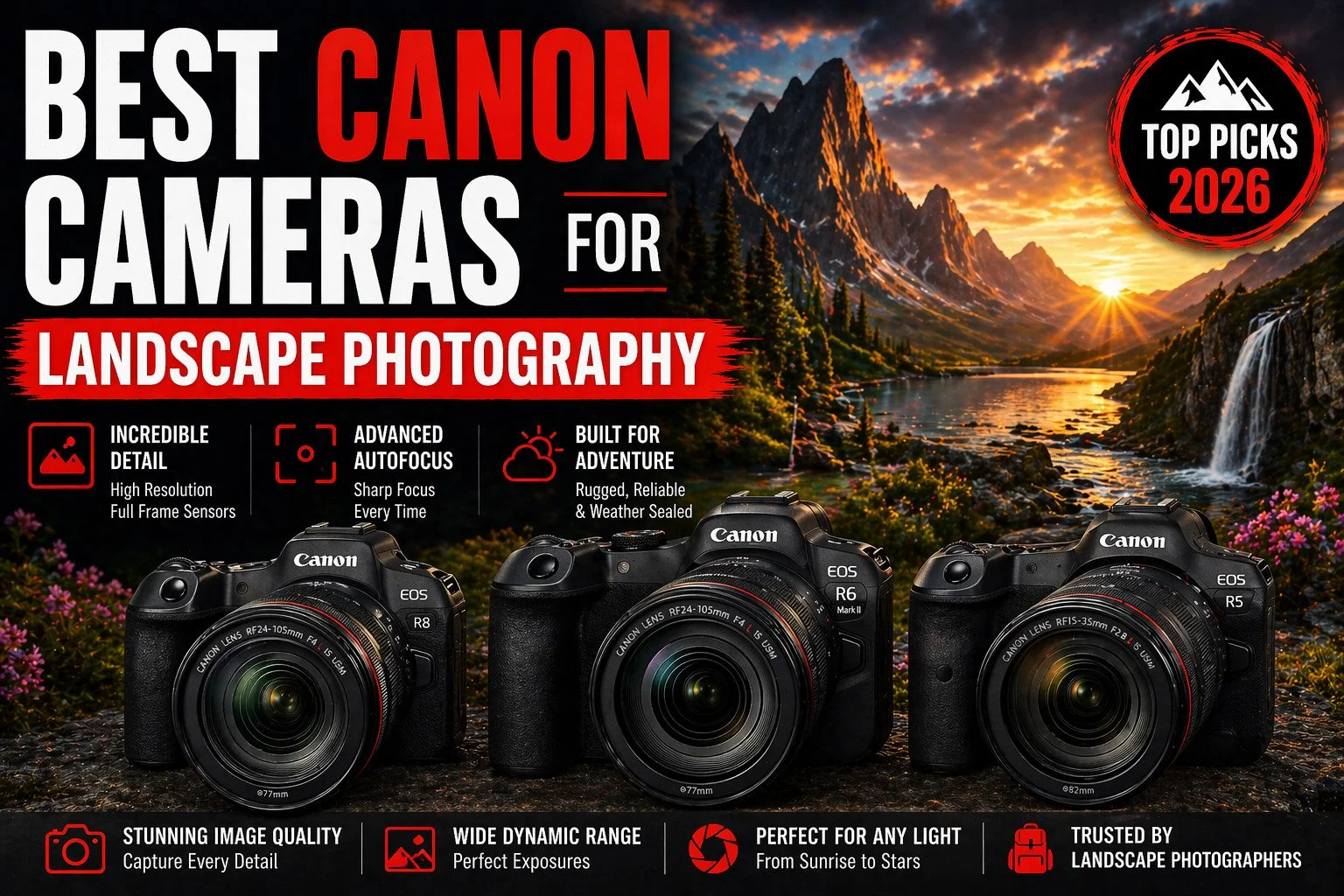
Best Canon Cameras for Landscape Photography (2026)
*Some links in this guide are affiliate links. If you purchase through them, it helps support my work at no extra cost to you.
==========
If you’re already shooting Canon, you’re in a strong position for landscape photography. The RF system has matured quickly, with high-resolution sensors, strong dynamic range, and a growing lineup of wide-angle lenses that make it easy to build a serious landscape kit.
If you’re comparing across brands, I break that down here: Best Cameras for Landscape Photography
This page focuses specifically on the best Canon cameras for landscape work in 2026, from high-resolution full-frame bodies to lighter APS-C options that are easier to carry into the field.
What Makes a Canon Camera Good for Landscape Photography?
Choosing the best Canon camera for landscape photography is about more than just megapixel count. Landscape photographers need a camera that can capture fine details, handle challenging lighting conditions, survive outdoor environments, and provide access to high-quality lenses that match different shooting styles.
The best Canon landscape cameras combine high-resolution sensors, excellent dynamic range, reliable weather protection, strong battery performance, and a wide selection of landscape-focused lenses.
High Megapixel Resolution
Resolution plays an important role in landscape photography because detailed scenes often contain fine textures such as foliage, rocks, mountains, and distant landscapes. A higher-megapixel sensor allows photographers to capture more detail and provides additional flexibility when cropping images or creating large prints.
Canon’s high-resolution cameras, such as the Canon EOS R5 Mark II and Canon EOS R5, are popular choices among landscape photographers because they provide enough detail for large-format prints while maintaining excellent image quality.
However, megapixels are not the only factor that matters. A camera with a slightly lower resolution sensor can still produce outstanding landscape images if it offers strong dynamic range, accurate colors, and excellent lenses.
Dynamic Range
Landscape photography often involves extreme differences between bright skies and darker foreground areas. Sunrise, sunset, forests, mountains, and coastal scenes can push a camera sensor’s ability to preserve highlight and shadow detail.
A camera with strong dynamic range allows photographers to recover more detail from shadows, retain color in bright skies, and create more natural-looking images during post-processing.
Canon’s newer mirrorless cameras have improved significantly in this area, providing better RAW file flexibility for photographers who edit in programs like Adobe Lightroom or Photoshop.
Weather Sealing
Landscape photographers frequently work in unpredictable outdoor conditions, including rain, snow, wind, dust, and coastal environments. A camera with weather sealing provides additional protection when shooting in challenging locations.
While no camera is completely waterproof, Canon’s higher-end mirrorless bodies are designed with weather-resistant construction that helps protect internal components when paired with appropriately sealed lenses.
For photographers who regularly hike, travel, or photograph locations such as mountains, beaches, and national parks, weather sealing is an important feature to consider.
Lens Availability
A great landscape camera needs access to high-quality lenses. Canon’s RF lens lineup offers a wide range of options for landscape photography, from ultra-wide-angle lenses for dramatic scenes to telephoto lenses for compressed mountain and wildlife landscapes.
Popular Canon landscape lens choices include:
Ultra-wide-angle lenses (14–24mm range): Ideal for large vistas, foreground interest, and dramatic perspective.
Standard zoom lenses (24–70mm range): Versatile options for everyday landscape photography and travel.
Telephoto lenses (70–200mm and longer): Great for isolating distant mountains, layered landscapes, and details.
The availability of Canon’s RF lenses, along with compatibility with many EF lenses through an adapter, gives photographers a large selection of tools for different environments.
Battery Life for Hiking and Travel
Landscape photographers often spend long hours outdoors waiting for the right light. A camera with reliable battery life reduces the need to carry multiple spare batteries or stop shooting during important moments.
Battery performance becomes especially important during cold-weather photography, long hikes, remote locations, and multi-day trips where charging options may be limited.
Canon mirrorless cameras have improved battery efficiency compared with earlier generations, but carrying at least one spare battery is still recommended for serious landscape work.
What Matters for Landscape Photography (Canon-Specific)
Canon bodies are generally strong across the board, but for landscapes, a few things matter more:
Resolution
If you print large or crop often, this is one of the biggest factors.
Dynamic range
Important for sunrise, sunset, and high-contrast scenes where you want to hold detail in both highlights and shadows.
IBIS + lens stabilization
Canon’s stabilization system is useful if you’re shooting handheld or traveling light.
RF lens ecosystem
This is a big advantage now. Canon has built out strong wide-angle options that pair well with landscape bodies.
Best Canon Cameras for Landscape Photography in 2026
Canon EOS R5 Mark II
Best overall Canon camera for landscapes
If you want the best Canon offers right now for landscape photography, this is it.
The EOS R5 Mark II builds on the original R5 with a 45MP full-frame sensor and faster performance across the board. For landscape work, the biggest advantage is the combination of resolution and flexibility. You can crop aggressively, print large, and still hold detail across the frame.
It is more camera than most landscape photographers strictly need, but it is also the safest long-term investment in the Canon system.
👉 Check current price on Amazon
👉 Check current price on Adorama
Canon EOS R6 Mark II
Best value full-frame option
If you don’t need 45MP, the R6 Mark II is a strong alternative.
At 24MP, it gives up some resolution, but still delivers solid image quality, strong dynamic range, and excellent overall performance. For photographers who prioritize file size, speed, and cost over maximum detail, this is a more practical choice.
It is also one of the more balanced cameras in Canon’s lineup if you shoot a mix of landscapes and general photography.
👉 Check current price on Amazon
👉 Check current price on Adorama
Canon EOS R7
Best APS-C camera for landscapes
The EOS R7 is one of the most underrated landscape cameras in Canon’s lineup.
With a 32.5MP APS-C sensor, it actually delivers a surprising amount of detail for its size. If you are hiking, traveling, or just trying to keep your kit lightweight, this is one of the best options available.
Pair it with a good wide-angle RF or adapted EF lens, and it becomes a very capable landscape setup.
👉 Check current price on Amazon
👉 Check current price on Adorama
Canon EOS R8
Best lightweight full-frame option
If you want full-frame without the weight or cost of the R5 line, the EOS R8 is worth considering.
It uses a 24MP sensor and keeps the body compact, making it a good fit for travel and casual landscape shooting. You are giving up some durability and high-end features, but the tradeoff is a much lighter setup.
👉 Check current price on Amazon
Which Canon Camera Should You Choose?
If you want a simple breakdown:
Maximum detail / serious landscape work → R5 Mark II
Balanced full-frame value → R6 Mark II
Lightweight and high-resolution APS-C → R7
Compact full-frame travel setup → R8
For most people, it comes down to how much resolution you actually need versus how much weight you are willing to carry.
Why Choose Canon for Landscape Photography?
Canon has become a much stronger landscape system than it was a few years ago.
RF lenses
Canon’s RF lineup now includes excellent wide-angle zooms that are well-suited for landscape work.
Color rendering
Canon’s color is often a personal preference, but many photographers prefer it for natural scenes.
Stabilization
Between IBIS and stabilized lenses, Canon makes handheld landscape shooting more realistic when needed.
Do You Need Full-Frame for Canon Landscape Work?
No.
The EOS R7 is proof that APS-C can still be very capable for landscape photography. Full-frame gives you more flexibility, especially with dynamic range and depth of field, but it is not required to produce strong landscape images.
Final Thoughts
If you want the best Canon camera for landscape photography in 2026, the EOS R5 Mark II is the clear top choice.
That said, not everyone needs that level of performance. The R6 Mark II, R7, and R8 all offer different balances of resolution, size, and cost, and for many photographers, one of those will actually be the better fit.
The best camera is the one you will consistently bring with you, especially for landscape work.
Frequently Asked Questions
Q: Is Canon good for landscape photography?
A: Yes. Canon’s modern RF system offers strong image quality, a growing lens lineup, and reliable performance for landscape work.
Q: R5 Mark II vs R6 Mark II for landscapes?
A: The R5 Mark II is better if you want maximum resolution and cropping flexibility. The R6 Mark II is a better value if 24MP is enough for your needs.
Q: What is the best budget Canon camera for landscape photography?
A: The EOS R7 is one of the best budget-friendly options, offering high resolution in a smaller, more affordable package.
Q: Do I need RF lenses for landscape photography?
A: Not necessarily. RF lenses are excellent, but adapted EF lenses can still perform very well for landscape work.
==========
Explore more:
